
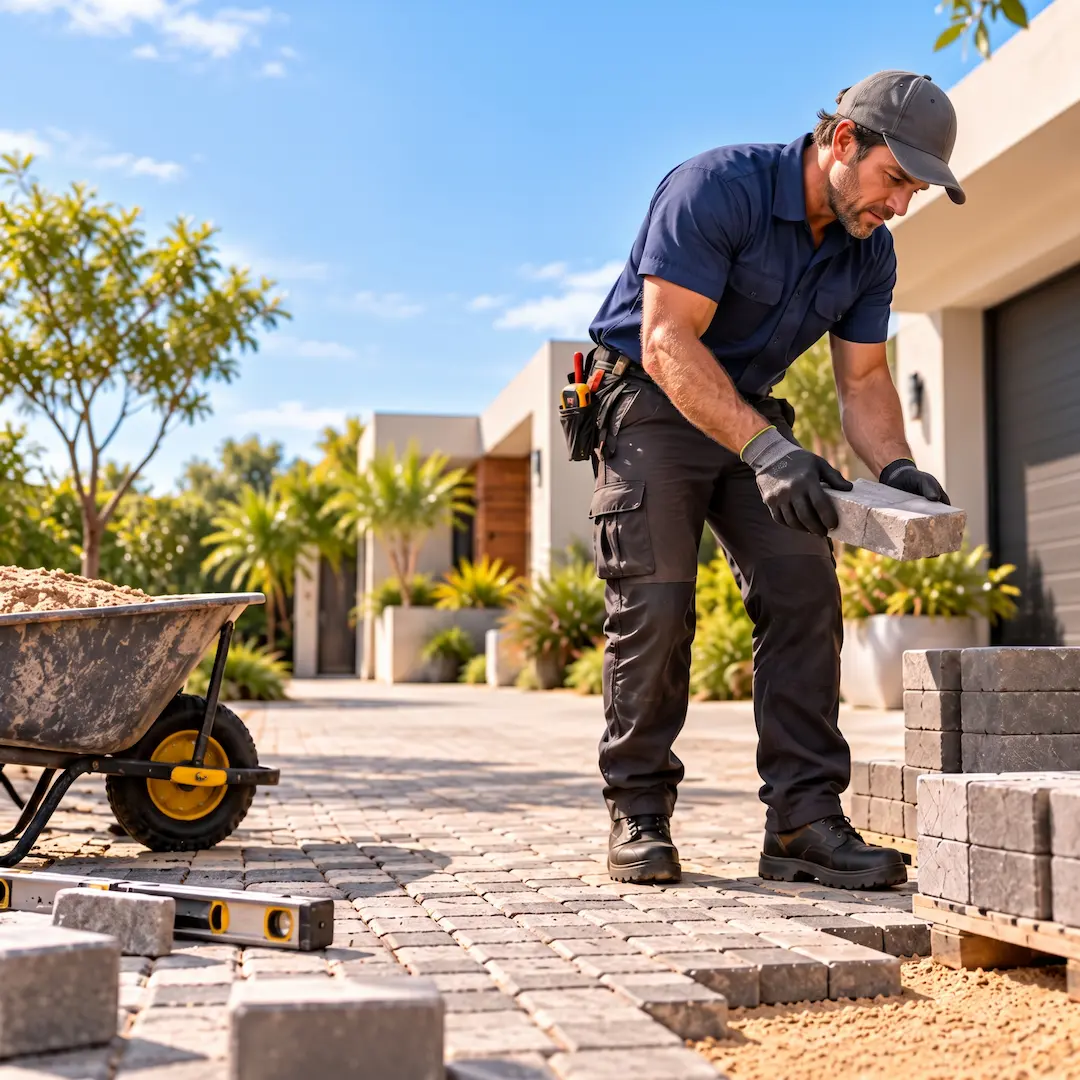
Driveway Paving Cost per Square Metre in 2026
See the 2026 driveway paving cost per square metre, what a fair quote includes and what's extra. Find a vetted paver on Kandua.com.

You've decided the driveway needs paving. Now the worry shifts to the quote. Will the price you agree on be the price you pay once the work starts? We get it. This guide sets out the typical driveway paving cost per square metre in South Africa for 2026, what a fair quote should include and the extras that can catch homeowners off guard.
What Is the Driveway Paving Cost per Square Metre in 2026?
Driveway paving is priced per square metre (m²). Current 2026 price guides put the typical ranges at:
- Labour only (you supply the pavers): R100 to R300 per m²
- Paving blocks only (materials): R200 to R400 per m²
- Supply and install with standard concrete paving bricks: R400 to R700 per m²
- Clay pavers, cobbles and large-format pavers: R550 to R950+ per m²
Where your project lands in that range depends on the paver you choose, how much digging and base work the site needs, access for deliveries and whether the driveway slopes.
What Does That Mean for a Typical Driveway?
Take a driveway 5 m wide and 8 m long. That's 40 m².
- At R400 to R700 per m² installed, you could expect roughly R16 000 to R28 000.
- If you supply your own pavers, labour at R100 to R300 per m² comes to R4 000 to R12 000. The pavers and base materials are then on you.
Measure your driveway before you ask for quotes. Length times width gives you the m². Now you can check every quote against the same number.
What Should a Driveway Paving Quote Include?
A clear quote shows what you're paying for, line by line. For a new driveway, look for:
- Excavation of the existing surface and levelling.
- A compacted sub-base. A domestic driveway typically needs 100 to 150 mm of compacted crusher-run or G5, laid in layers.
- 20 to 30 mm of bedding sand under the pavers.
- Pavers rated for vehicles. Interlocking concrete pavers of around 60 mm or more are commonly used for residential driveways, depending on the vehicle load and manufacturer’s specification. Thin patio pavers may not be suitable for vehicular use.
- Cutting, compacting and jointing sand.
- A fall, so water runs off instead of pooling.
- A split between labour and materials.
What to Look for in a Detailed Quote
A fair, transparent driveway paving quote should explicitly itemise:
- Site Preparation & Earthworks: Depth of excavation specified (e.g., excavating to 150–200mm) and specific grading or slope adjustments for water runoff.
- Sub-base Specifications: Exact thickness and material specification for the sub-base (e.g., 100–150mm of G5 or crusher-run compacted in layers).
- Bedding & Jointing: Sand layer thickness (20–30mm) and joint-filling method.
- Paver Details: Exact manufacturer, style, color, and thickness (minimum 60mm for vehicular traffic) of the pavers.
- Perimeter Containment: Line items for concrete edge beams, header courses, or kerbing to prevent lateral shifting.
- Ancillary Works: Separate line items for rubble removal, breaking out existing concrete/tar, or installing drainage channels/acuvents.
- Labor vs. Materials: A clear financial split if materials are not fully bundled.
- Variation Protocol: Clear terms outlining how any unforeseen site conditions (e.g., underground rock or hidden services) will be quoted and approved before extra work begins.
What Costs Can Be Added on Top?
Some items are usually priced separately from the per m² rate:
- Edging and kerbing along the sides of the driveway.
- Rubble removal, especially when old concrete or tar is broken out.
- Drainage channels or retaining edges on sloped driveways.
- Breaking out a cracked or uneven concrete driveway before paving.
None of these are hidden costs if they're on the quote from day one. They only become a problem when they appear halfway through the job.
How Do I Know If a Driveway Paving Quote Is Fair?
An unclear quote can make it harder to tell whether you’re getting a fair price.
Before you say yes, check:
- Is the area measured in m², and does it match your own measurement?
- Is the base depth written down?
- Are the paver type and thickness named?
- Are edging, rubble removal and drainage priced, or clearly marked as not needed?
- Is it clear how any change will be priced and agreed before extra work starts?
If a professional can't answer these, it could be a sign the job hasn't been scoped properly.
Why Isn't the Lowest Quote Always the Correct One?
The base carries the weight of your cars. A quote well below the range could mean less base depth or less compaction. That can show up later as sinking, ruts or loose pavers, and fixing it means lifting and relaying the paving. If an older driveway has already started to sink, a pro can assess whether paving repair, lift and relay is enough before you pay for a full new driveway.
The correct price is the one that covers the work your driveway actually needs.
How Does Kandua Help You Avoid Surprise Costs?
When you book driveway paving through Kandua.com, we connect you with 4.5+ rated, background-checked professionals near you.
For more on budgeting for work around the home, read How Much Does Home Renovation Cost in South Africa? A Complete Budgeting Guide.
Frequently Asked Questions
How much does it cost to pave a 40 m² driveway?
At R400 to R700 per m² installed with standard concrete pavers, a 40 m² driveway could cost roughly R16 000 to R28 000. Your final price depends on the pavers, the base work and any extras on your quote.
Can I supply my own pavers to save money?
Yes, you can ask for a labour-only quote. Labour typically runs at R100 to R300 per m². Agree upfront who handles delivery, breakages and base materials.
Can I pave over my existing concrete driveway?
Sometimes. The surface needs to be sound and level, with enough height at doorways and the garage threshold. Cracked or uneven concrete should be broken out, which adds to the cost.
How long does driveway paving take?
A typical single or double driveway takes three to five days. Larger or sloped driveways, and jobs that need drainage, take longer.
What thickness of paver do I need for a driveway?
Driveways need pavers rated for vehicle loads. Interlocking concrete pavers of 60 mm or more are the most popular choice.
Why do clay and cobble driveways cost more?
Clay, cobble and large-format pavers are priced higher than standard concrete pavers, so the installed price per m² goes up. A vetted pro can show you the difference on your quote.
Ready for a quote? Find a vetted paver on Kandua.com. We've got you.
Suzette Meyer is the lead author and content creator for Kandua.com, South Africa’s #1 marketplace for home services. Suzette has made it her mission to help homeowners with advice on all aspects of home repair, maintenance and improvement, including how to choose the right Pro and how to make smart upgrades that improve your resale value or save costs.

Latest articles, advice and more
.webp)
.jpg)
Sinking Pavers, Weeds and Water That Pools: What Your Driveway Is Telling You
When your driveway starts sprouting weeds, pooling water, or sinking in patches, the bricks are not failing you. The layers underneath have moved, and they are trying to tell you exactly what went wrong.
.jpg)
What Your Garage Door Motor Actually Does (And Why It Breaks)
Spoiler alert: your garage door motor isn't actually doing the heavy lifting. The torsion springs carry almost all the weight. The motor simply pushes, pulls, controls the descent so it doesn't slam, and acts as a lock when the door is shut. That’s why a relatively small box on your ceiling can move such a massive door. Want to test this? Pull the red manual release cord and lift the door by hand. If it glides up easily and stays put when you let go, your springs are doing their job, and the fault lies with the motor. If the door feels like dead weight or slams back down- stop. You’ve got a spring problem.
.jpg)
4 Warning Signs Your Tiles Are Failing (And What They Mean)
Tiles rarely fail overnight. They warn you first. A hollow sound underfoot, grout that crumbles away, a tile that lifts at one edge, or a crack that runs across two tiles all point to something happening under the surface. Here is what each sign means, and how urgent it is.
.jpg)
Braai Area Rust, Cracked Paint And Dodgy Outdoor Plugs: The Heritage Day Checklist
Braai area maintenance before Heritage Day comes down to three jobs: strip and treat rust on the braai stand and steel fittings, repair cracked or flaking exterior paint, and have a qualified electrician check every outdoor plug and light. Start two weeks out so coatings have time to cure properly.
.webp)
.webp)
Beyond the Unboxing: A Detailed Guide to Correct Washing Machine Plumbing & Setup
New washing machine in South Africa? Learn essential plumbing and setup tips to prevent leaks, ensure efficient operation, and extend your appliance’s lifespan - expert advice before your first load.
.webp)
New Washing Machine? Don't Plug It In Yet! Essential Installation Tips for SA Homes
Installing a new washing machine? Learn the essential setup steps South African homeowners often overlook to prevent leaks, noise, and damage—and ensure efficient, long-lasting performance from day one.
%201200%20x%201200%20(1).jpg)
What Retiling a Bathroom Costs in 2026, Room by Room
Retiling a bathroom in South Africa costs between R230 and R800 per square metre in 2026, including materials and labour. A standard family bathroom, stripped and fully retiled, usually lands between R11,800 and R27,500. A guest toilet costs a fraction of that. A large porcelain en-suite costs a lot more.
.webp)
TV Repair Costs in South Africa: Diagnosing Screen, Power & Component Issues
Find out what TV repairs really cost in South Africa – from call-out and diagnosis fees to screen, power and main board fixes – and when it’s cheaper to replace your TV instead of repairing it.
.webp)
Septic Tank Leak Repair Cost in South Africa: Addressing Odours & Environmental Hazards
Learn typical septic tank leak repair costs in South Africa, what drives the price up, how to spot early warning signs (odours, soggy ground, backups), and when it’s safer and cheaper to get a professional in.
How to Install a Horizontal Geyser | Step-by-Step Pro Guide
Want to install a geyser like a pro? This step-by-step tutorial shows you exactly how to do a horizontal Ariston Axios geyser installation, straight from the BluLever plumbing workshop. 🎥 Hosted by MK, BluLever’s technical facilitator, and supported by a qualified electrician, Life and a BluLever graduate artisan, Zinhle. This is your ultimate guide to a SANS 10254-compliant installation — from preparing the wall, to plumbing, electrical wiring, and pro troubleshooting tips.
How to Maintain a Geyser | Step-by-Step Pro Guide
Want to maintain a geyser like a pro? This step-by-step tutorial shows you exactly how to do the three core geyser maintenance checks on an Ariston Axios geyser installation, straight from the BluLever plumbing workshop. 🎥 Hosted by MK, BluLever’s technical facilitator, and supported by a qualified electrician, Life. This is your ultimate guide to geyser maintenance — from diagnosing the problem to checking the heat regulation of the geyser, to pressure regulation and then finally corrosion protection.
%201.avif)
Not just another newsletter. It's an advantage