
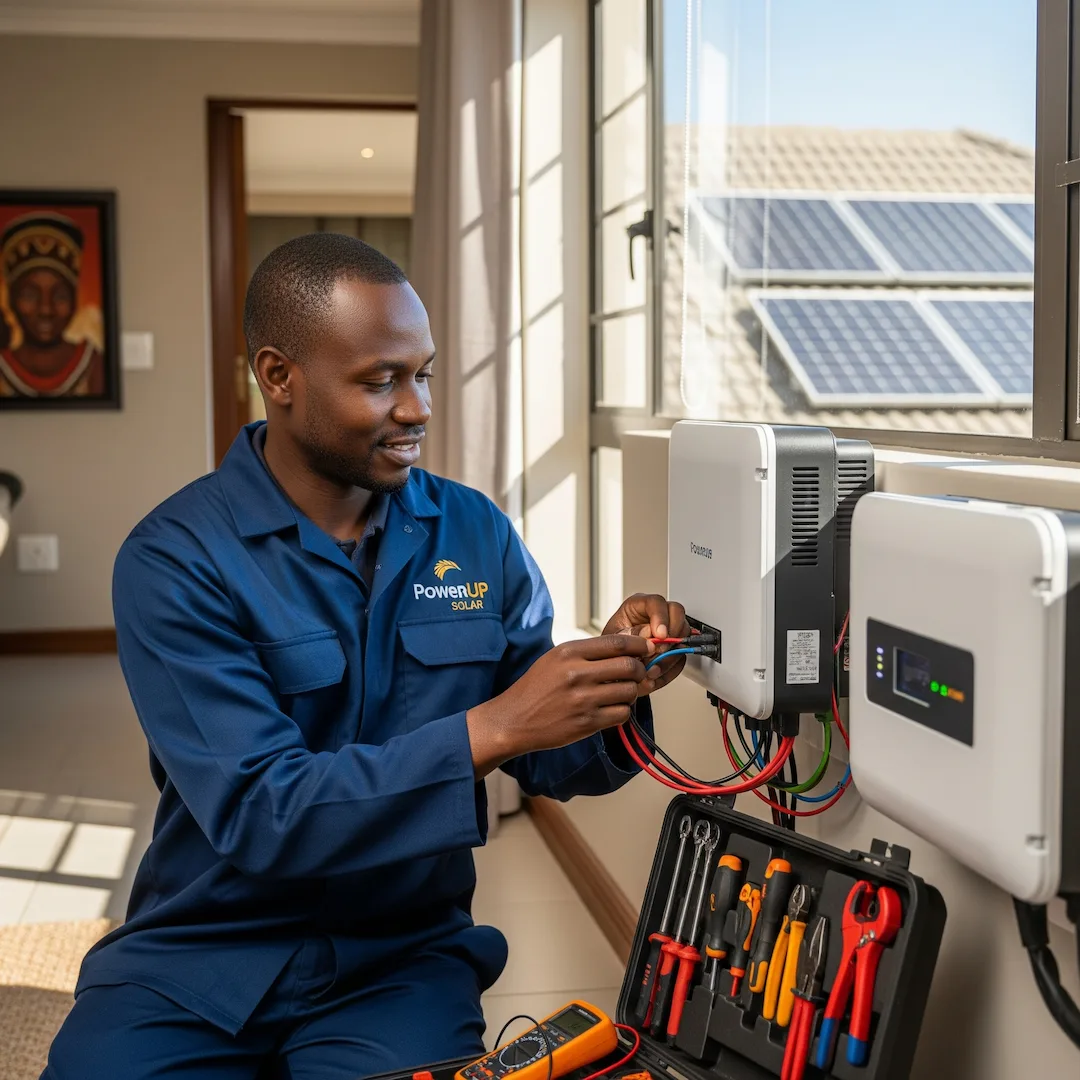
Going Solar in SA: Choosing Qualified Installers for Reliable Backup Power and Energy Savings
Going solar in South Africa? Learn how to choose qualified installers to ensure safe installation, reliable backup power, and maximum long-term energy savings - essential guidance before you invest.

Going Solar in SA: Choosing Qualified Installers for Reliable Backup Power and Energy Savings
The decision is made. You're tired of load shedding, concerned about rising electricity tariffs, and ready to invest in a solar power system for your home. It’s a smart move that promises energy independence and long-term savings. But now you face the most critical step of the entire process: choosing the right people to install it.
This isn't like picking a painter or a garden service. A solar installation is a complex electrical and structural project that integrates directly into your home's power grid. The quality of the installation is just as important—if not more so—than the quality of the panels and inverter you choose. Getting it right means years of reliable, safe, and efficient power. Getting it wrong can lead to underperformance, safety hazards, and costly repairs.
As a South African homeowner on the verge of this significant investment, understanding how to identify a qualified, professional installer is paramount. This guide is designed to walk you through exactly that, ensuring your journey into solar energy is a resounding success.
Why Your Choice of Solar Installer Matters More Than You Think
We often hear from homeowners who, in an attempt to save a few thousand rands, opted for the cheapest quote they could find. One particularly telling story came from a family in Durbanville. They had a system installed that never seemed to produce the power they were promised. During a routine inspection by a different, certified professional, it was discovered that the panels were installed at the wrong angle and orientation for their specific roof, drastically reducing their energy generation. The wiring was also poorly done, posing a potential fire risk. They ended up paying a premium to have the entire system safely re-installed, wiping out any initial savings.
This scenario highlights a crucial truth: a solar installation is a long-term investment. The expertise of your installer directly impacts its safety, performance, and lifespan.
Here’s why a professional installation is non-negotiable:
- Safety First: You are dealing with high-voltage Direct Current (DC) electricity from the panels, which behaves differently from the Alternating Current (AC) in your home. Incorrect wiring, poor connections, or improper grounding can create serious fire hazards and risks of electric shock.
- Regulatory Compliance: In South Africa, specific rules govern how power generation systems are connected to a property and the grid. A qualified installer will ensure your system complies with municipal bylaws and national standards like SANS 10142-1 and NRS 097-2-1. This is essential for safety, insurance purposes, and for obtaining a valid Electrical Certificate of Compliance (CoC).
- Maximising Your Investment: A professional understands how to optimise your system for maximum energy generation. This involves correct panel placement (azimuth and tilt), proper component matching (inverter, batteries, panels), and ensuring minimal energy loss through efficient wiring.
- Protecting Your Warranties: Top-tier solar components come with lengthy manufacturer warranties, often spanning 10 to 25 years. However, these warranties are almost always contingent on the system being installed by a certified professional according to the manufacturer's specifications. A shoddy installation can void them instantly.
- System Longevity: A well-installed system is built to last. Professional installers use the correct, weather-resistant mounting hardware, ensure proper ventilation for inverters and batteries, and seal any roof penetrations correctly to prevent leaks. This attention to detail protects your system and your home from damage over time.
What to Look for in a Qualified Solar Installer in South Africa
Now that you understand the stakes, how do you sift through the options to find a truly competent professional? Here are the key things you must verify before signing any contract.
1. Essential Certifications and Qualifications
Don't just take their word for it; ask for proof. A reputable installer will be happy to provide their credentials.
- PV GreenCard: This is the gold standard for solar PV installers in South Africa. Developed by the South African Photovoltaic Industry Association (SAPVIA), the PV GreenCard programme provides training and a checklist for quality and safety. An installer who can issue a PV GreenCard for your installation is demonstrating their commitment to industry best practices.
- Qualified Electrician with a Wireman's Licence: The final connection of the solar system to your home's distribution board (DB) must be done and signed off by a registered electrician who holds a valid Wireman's Licence. This is a legal requirement for issuing the Electrical Certificate of Compliance (CoC).
- Letter of Good Standing: This shows the company is registered and up-to-date with the Compensation Fund, covering their employees in case of injury on your property.
2. Proven Experience and a Verifiable Track Record
Experience is a powerful indicator of expertise. A new company isn't necessarily a bad choice, but they should have experienced individuals on their team.
- Ask for a Portfolio: Request to see photos of their previous installations. Pay attention to the details. Is the wiring neat and tidy, especially around the inverter and DB board? Are the panels on the roof perfectly aligned and securely mounted? One of our expert pros always tells us, "You can judge an entire installation by the neatness of the trunking and wiring. If they cut corners on what you can see, imagine the corners they cut on what you can't."
- Request References: Ask for contact details of one or two recent clients. A confident installer with a history of happy customers won't hesitate.
- Check Their Knowledge: Ask them questions about the products they are proposing. Why this inverter over another? Why this type of battery? A true expert can explain their choices in a way you can understand, justifying them based on your specific needs, not just what they have in stock.
3. A Detailed, Transparent Quotation
The cheapest quote is often the most expensive in the long run. A professional quote should be a detailed document, not a single-line item on an invoice. It must include:
- A clear breakdown of all major components: makes, models, and quantities of solar panels, the inverter, and batteries.
- Costs for all other materials: mounting structures, cabling, trunking, circuit breakers, etc.
- A clear outline of the labour costs.
- The cost for the Certificate of Compliance (CoC) and, if applicable, the PV GreenCard.
- Clearly stated payment terms and warranty information for both components and workmanship.
Red Flags to Watch Out For
Be wary of installers who:
- Provide a vague quote with little detail on the components.
- Offer a price that seems too good to be true. This often means they are using sub-par "grey market" products or cutting corners on safety.
- Pressure you into making a quick decision with "limited time" offers.
- Are unable or unwilling to provide proof of their certifications or references.
- Suggest you don't need a Certificate of Compliance (CoC). This is a major red flag and is illegal.
The Installation Process: What to Expect
A professional installation follows a clear, structured process to ensure quality and safety.
- Site Assessment and Design: The installer will visit your home to inspect your roof, your current electrical setup (DB board), and discuss your energy needs. They will analyse your electricity bills to correctly size the system.
- Installation: The team will mount the panels on the roof, run the DC cabling to the inverter's location, and install the inverter and batteries. This requires precision and care to ensure everything is secure and weatherproof.
- Electrical Work: The qualified electrician will connect the inverter to the batteries and integrate the system into your home's main distribution board.
- Commissioning and Handover: The system will be switched on and tested to ensure everything is working correctly. The installer should then walk you through how the system works, what the different lights on the inverter mean, and how to use any monitoring apps.
- Documentation: Upon completion, you must receive the critical documents: the Electrical Certificate of Compliance (CoC), all component manuals and warranty documents, and the PV GreenCard.
Making the move to solar is an exciting step towards a more stable and sustainable energy future. By taking the time to choose a qualified, certified, and experienced installer, you are not just buying a product; you are investing in peace of mind, safety, and the long-term performance of your system.
Frequently Asked Questions
What is a Certificate of Compliance (CoC) and why is it essential for my solar installation?
A Certificate of Compliance is a legal document issued by a registered electrician that declares your electrical installation is safe and complies with South African regulations (SANS 10142-1). For a solar installation, it's mandatory. It certifies that the system has been installed correctly and safely. Without a valid CoC, your home insurance may refuse to pay out in the event of a fire or damage caused by the system.
Do I need my municipality's permission to install a solar backup system?
It depends on the type of system and your municipality. For a grid-tied system (one that can feed excess power back into the grid), you absolutely need municipal approval. For off-grid or hybrid backup systems (like those for load shedding), the rules can vary. A professional installer will be aware of the specific requirements for your area and can guide you through the application process if one is needed.
How long should a standard residential solar backup installation take?
For a typical residential backup system (e.g., a 5kW inverter, a battery, and 8-10 panels), a professional team can usually complete the physical installation within one to three days. The exact timeframe depends on the complexity of the job, the size of the system, and weather conditions.
Can a bad installation really damage my home appliances?
Yes, absolutely. A poorly installed solar system can produce "dirty" power with unstable voltage or frequency. This can damage sensitive electronics like TVs, computers, fridges, and even LED lights over time. A professional installation with a quality inverter ensures that the power delivered to your home is a clean, stable sine wave, just like (or better than) what you get from the grid, protecting your valuable appliances.
Find a vetted electrician near you
Solar installations: find a pro near you
Suzette Meyer is the lead author and content creator for Kandua.com, South Africa’s #1 marketplace for home services. Suzette has made it her mission to help homeowners with advice on all aspects of home repair, maintenance and improvement, including how to choose the right Pro and how to make smart upgrades that improve your resale value or save costs.

Latest articles, advice and more
.webp)
.webp)
.jpeg)
Sinking Pavers, Weeds and Water That Pools: What Your Driveway Is Telling You
When your driveway starts sprouting weeds, pooling water, or sinking in patches, the bricks are not failing you. The layers underneath have moved, and they are trying to tell you exactly what went wrong.
.jpeg)
What Your Garage Door Motor Actually Does (And Why It Breaks)
Spoiler alert: your garage door motor isn't actually doing the heavy lifting. The torsion springs carry almost all the weight. The motor simply pushes, pulls, controls the descent so it doesn't slam, and acts as a lock when the door is shut. That’s why a relatively small box on your ceiling can move such a massive door. Want to test this? Pull the red manual release cord and lift the door by hand. If it glides up easily and stays put when you let go, your springs are doing their job, and the fault lies with the motor. If the door feels like dead weight or slams back down- stop. You’ve got a spring problem.
.jpeg)
4 Warning Signs Your Tiles Are Failing (And What They Mean)
Tiles rarely fail overnight. They warn you first. A hollow sound underfoot, grout that crumbles away, a tile that lifts at one edge, or a crack that runs across two tiles all point to something happening under the surface. Here is what each sign means, and how urgent it is.
.webp)
.webp)
Beyond the Unboxing: A Detailed Guide to Correct Washing Machine Plumbing & Setup
New washing machine in South Africa? Learn essential plumbing and setup tips to prevent leaks, ensure efficient operation, and extend your appliance’s lifespan - expert advice before your first load.
.webp)
New Washing Machine? Don't Plug It In Yet! Essential Installation Tips for SA Homes
Installing a new washing machine? Learn the essential setup steps South African homeowners often overlook to prevent leaks, noise, and damage—and ensure efficient, long-lasting performance from day one.
.webp)
.webp)
%25201200%2520x%25201200%2520(1).jpeg)
What Retiling a Bathroom Costs in 2026, Room by Room
Retiling a bathroom in South Africa costs between R230 and R800 per square metre in 2026, including materials and labour. A standard family bathroom, stripped and fully retiled, usually lands between R11,800 and R27,500. A guest toilet costs a fraction of that. A large porcelain en-suite costs a lot more.
How to Install a Horizontal Geyser | Step-by-Step Pro Guide
Want to install a geyser like a pro? This step-by-step tutorial shows you exactly how to do a horizontal Ariston Axios geyser installation, straight from the BluLever plumbing workshop. 🎥 Hosted by MK, BluLever’s technical facilitator, and supported by a qualified electrician, Life and a BluLever graduate artisan, Zinhle. This is your ultimate guide to a SANS 10254-compliant installation — from preparing the wall, to plumbing, electrical wiring, and pro troubleshooting tips.
How to Maintain a Geyser | Step-by-Step Pro Guide
Want to maintain a geyser like a pro? This step-by-step tutorial shows you exactly how to do the three core geyser maintenance checks on an Ariston Axios geyser installation, straight from the BluLever plumbing workshop. 🎥 Hosted by MK, BluLever’s technical facilitator, and supported by a qualified electrician, Life. This is your ultimate guide to geyser maintenance — from diagnosing the problem to checking the heat regulation of the geyser, to pressure regulation and then finally corrosion protection.
%201.avif)
Not just another newsletter. It's an advantage