
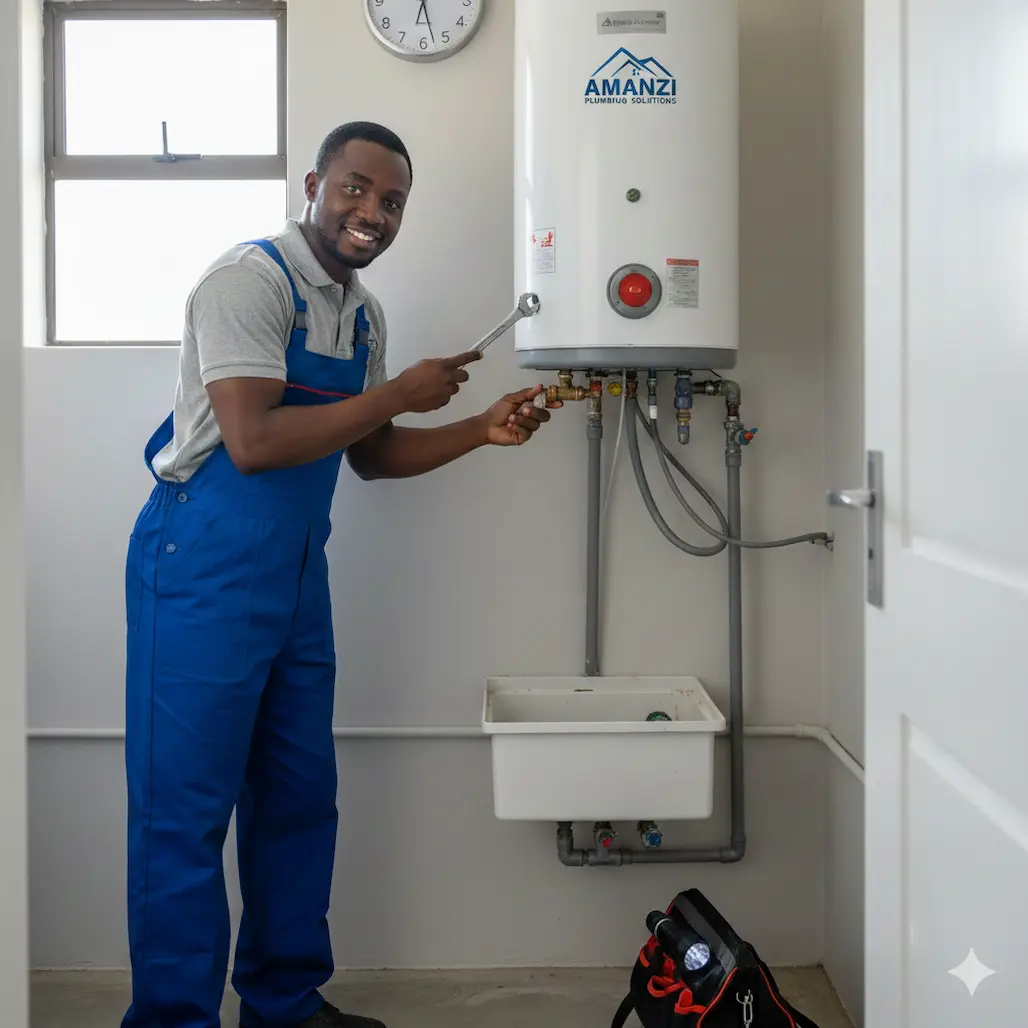
How to Tell If Your Geyser Is About to Burst
Geysers rarely burst without giving you a few hints first. By spotting the early warning signs, you can turn a potential disaster into a managed repair job. This guide, compiled with insights from top-rated plumbers in the Kandua network, will help you determine whether your geyser is a ticking time bomb and what to do about it.

There is perhaps no sound more dreaded by a South African homeowner than the sudden crash of a ceiling board followed by a torrent of hot water flooding the hallway. A burst geyser is more than just an inconvenience; it is a major structural risk and a financial headache.
However, geysers rarely burst without giving you a few hints first. By spotting the early warning signs, you can turn a potential disaster into a managed repair job.
This guide, compiled with insights from top-rated plumbers in the Kandua network, will help you identify if your geyser is a ticking time bomb and precisely what to do about it.
Safety Warning: Working with geysers involves high-voltage electricity and scalding water. Under South African law (SANS 10254), geyser installation and major repairs must be carried out by a qualified plumber. Do not attempt to open or repair the geyser cylinder yourself.
5 Telltale Signs Your Geyser Is About to Fail
Most geysers in South Africa have a lifespan of roughly 5 to 10 years, depending on water quality and maintenance. If yours is nearing this age, keep a close eye (and ear) out for these symptoms.
1. The "Kettling" Sound
If you hear rumbling, popping, or hissing noises coming from your roof, your geyser is struggling.
- What it means: In areas with "hard" water, such as many parts of Gauteng and the Free State, mineral sediment builds up at the bottom of the tank. As the element heats up, it boils the water trapped under the sediment, causing bubbles to pop violently.
- The risk: This sediment creates hot spots that can crack the tank's inner lining, leading to a burst.
2. Rust-Coloured Water
Run your hot tap into a clear glass. If the water looks brownish, rusty, or slightly muddy, the inside of your geyser is corroding.
- What it means: Steel geysers are lined to prevent rust, but once that lining fails, the steel begins to rot away.
- The risk: Once corrosion starts, a leak is inevitable. It is often a sign that the sacrificial anode (a rod designed to attract rust away from the tank) is depleted.
3. Damp Patches on the Ceiling
Look up. If you see yellow or brown water stains on your ceiling boards, or if the paint is bubbling, you likely already have a slow leak.
- Expert Insight: Sipho, a qualified plumber operating in Johannesburg, notes: "Many homeowners ignore small damp spots, thinking it's a roof leak from rain. But if it hasn't rained in three days and the spot is growing, it’s almost certainly your geyser or the vacuum breakers leaking into the drip tray."
4. The Overflow Pipe is Dripping Constantly
Every geyser has a T&P (Temperature and Pressure) safety valve. It is normal for this to drip slightly as the water heats up (due to expansion). However, if water is streaming out of the white PVC pipe protruding from your roof or wall, something is wrong.
- What it means: The pressure inside the tank has become dangerously high, or the valve itself has failed.
5. Lukewarm Water or Tripping Electricity
If your water isn't getting hot, or if your earth leakage on the DB board trips every time the geyser switches on, the electrical components are wet or faulty. While this might be a thermostat or element issue, it often happens because a leak has dripped onto the electrical cover.
Immediate Action Plan: What to Do in an Emergency
If you notice any of the signs above, do not wait. Follow this procedure immediately to minimise damage.
Step 1: Cut the Power.
Go to your main Distribution Board (DB) and flip the switch labelled "Geyser" or "Water Heater" to the OFF position. This prevents the element from burning out if the water drains away and eliminates the risk of electrical shock.
Step 2: Shut Off the Water
Locate the water mains stopcock (usually near your water meter on the street verge or just outside the kitchen/scullery) and turn it off.
- Tip: If you have a specific stopcock installed on the cold-water inlet pipe feeding the geyser, you can turn it off instead, allowing you still to use cold water in the rest of the house.
Step 3: Relieve the Pressure
Open the hot water taps in your bath and basin. This relieves the pressure inside the tank.
- Warning: The water may be scalding hot or steam may escape. Be very careful.
Step 4: Assess the Drip Tray
If you can safely access your trapdoor, check if the drip tray is full. Modern installations (compliant with SANS 10254) must have a drip tray with an overflow pipe that leads outside. If the tray is blocked, you might need to carefully clear the blockage to let the water drain outside rather than onto your ceiling.
After the Repair: What if the Problem Returns?
A common frustration for homeowners is thinking the problem is solved, only to see water dripping again shortly after the plumber leaves.
Scenario: You paid for a valve replacement or a new element gasket. The plumber tests it, it looks dry, and they leave. Two hours later, you see a drip.
Check 1: Is it residual water?
Sometimes, water that spilt into the drip tray during the repair takes time to drain out. This should stop within a few hours.
Check 2: Is it expansion?
As mentioned earlier, a slight dribble from the overflow pipe during the heating cycle is normal expansion. It should stop once the geyser reaches temperature.
Check 3: Is it a workmanship issue?
If the flow is constant or the leak is coming from a connection point (nut/joint) that was just worked on, call the plumber back immediately.
- Trust factor: Reputable service providers, like those vetted by Kandua, should offer a workmanship guarantee. Do not feel bad about recalling them to fix a recurring leak on a job they just finished. It is their responsibility to ensure the system is watertight.
The Cost of Neglect vs. Replacement
Replacing a geyser is an unexpected expense, but the cost of not replacing it is often higher due to water damage to cupboards, laminated flooring, and ceilings.
- Estimated Replacement Cost: In South Africa, a standard 150L geyser replacement (supply and fit) typically ranges between R6,500 and R10,500 depending on the complexity of the installation and access to the roof space.
- Insurance: Most building insurance policies cover the resultant damage (the ceiling and floors) and the replacement of the geyser unit itself, though you may be liable for the excess.
For a more detailed breakdown of pricing, see our Plumbing Cost Guide.
Frequently Asked Questions
How often should I service my geyser in South Africa?
You should have your geyser checked by a qualified plumber every 2 to 3 years. This service usually involves checking the magnesium anode (which prevents rust) and replacing it if necessary. In areas with poor water quality, annual checks are recommended to extend the unit's lifespan.
Can I patch a leaking geyser tank?
No. Once the inner cylinder of a geyser has cracked or rusted through, it cannot be safely patched. The vessel's structural integrity is compromised, and it effectively becomes a pressure bomb. The entire unit must be replaced to comply with safety standards.
Why does my geyser burst in winter?
Geysers are more prone to bursting in winter due to the significant temperature difference. The cold water entering the tank creates a rapid expansion-and-contraction cycle (thermal shock) against the hot metal interior. If the tank is already weakened by rust, this stress can cause it to split.
My plumber mentioned a "Vacuum Breaker" – what is that?
A vacuum breaker is a small brass valve installed on the water pipes above the geyser. It prevents the geyser from collapsing inwards (imploding) if the water supply is suddenly cut off and the tank drains. It is a mandatory safety component under SANS 10254 regulations.
For more information on South African plumbing standards, you can visit the Plumbing Industry Registration Board (PIRB).
Suzette Meyer is the lead author and content creator for Kandua.com, South Africa’s #1 marketplace for home services. Suzette has made it her mission to help homeowners with advice on all aspects of home repair, maintenance and improvement, including how to choose the right Pro and how to make smart upgrades that improve your resale value or save costs.

Latest articles, advice and more
.webp)
.webp)
.jpeg)
Sinking Pavers, Weeds and Water That Pools: What Your Driveway Is Telling You
When your driveway starts sprouting weeds, pooling water, or sinking in patches, the bricks are not failing you. The layers underneath have moved, and they are trying to tell you exactly what went wrong.
.jpeg)
What Your Garage Door Motor Actually Does (And Why It Breaks)
Spoiler alert: your garage door motor isn't actually doing the heavy lifting. The torsion springs carry almost all the weight. The motor simply pushes, pulls, controls the descent so it doesn't slam, and acts as a lock when the door is shut. That’s why a relatively small box on your ceiling can move such a massive door. Want to test this? Pull the red manual release cord and lift the door by hand. If it glides up easily and stays put when you let go, your springs are doing their job, and the fault lies with the motor. If the door feels like dead weight or slams back down- stop. You’ve got a spring problem.
.jpeg)
4 Warning Signs Your Tiles Are Failing (And What They Mean)
Tiles rarely fail overnight. They warn you first. A hollow sound underfoot, grout that crumbles away, a tile that lifts at one edge, or a crack that runs across two tiles all point to something happening under the surface. Here is what each sign means, and how urgent it is.
.webp)
.webp)
Beyond the Unboxing: A Detailed Guide to Correct Washing Machine Plumbing & Setup
New washing machine in South Africa? Learn essential plumbing and setup tips to prevent leaks, ensure efficient operation, and extend your appliance’s lifespan - expert advice before your first load.
.webp)
New Washing Machine? Don't Plug It In Yet! Essential Installation Tips for SA Homes
Installing a new washing machine? Learn the essential setup steps South African homeowners often overlook to prevent leaks, noise, and damage—and ensure efficient, long-lasting performance from day one.
.webp)
.webp)
%25201200%2520x%25201200%2520(1).jpeg)
What Retiling a Bathroom Costs in 2026, Room by Room
Retiling a bathroom in South Africa costs between R230 and R800 per square metre in 2026, including materials and labour. A standard family bathroom, stripped and fully retiled, usually lands between R11,800 and R27,500. A guest toilet costs a fraction of that. A large porcelain en-suite costs a lot more.
How to Install a Horizontal Geyser | Step-by-Step Pro Guide
Want to install a geyser like a pro? This step-by-step tutorial shows you exactly how to do a horizontal Ariston Axios geyser installation, straight from the BluLever plumbing workshop. 🎥 Hosted by MK, BluLever’s technical facilitator, and supported by a qualified electrician, Life and a BluLever graduate artisan, Zinhle. This is your ultimate guide to a SANS 10254-compliant installation — from preparing the wall, to plumbing, electrical wiring, and pro troubleshooting tips.
How to Maintain a Geyser | Step-by-Step Pro Guide
Want to maintain a geyser like a pro? This step-by-step tutorial shows you exactly how to do the three core geyser maintenance checks on an Ariston Axios geyser installation, straight from the BluLever plumbing workshop. 🎥 Hosted by MK, BluLever’s technical facilitator, and supported by a qualified electrician, Life. This is your ultimate guide to geyser maintenance — from diagnosing the problem to checking the heat regulation of the geyser, to pressure regulation and then finally corrosion protection.
%201.avif)
Not just another newsletter. It's an advantage