
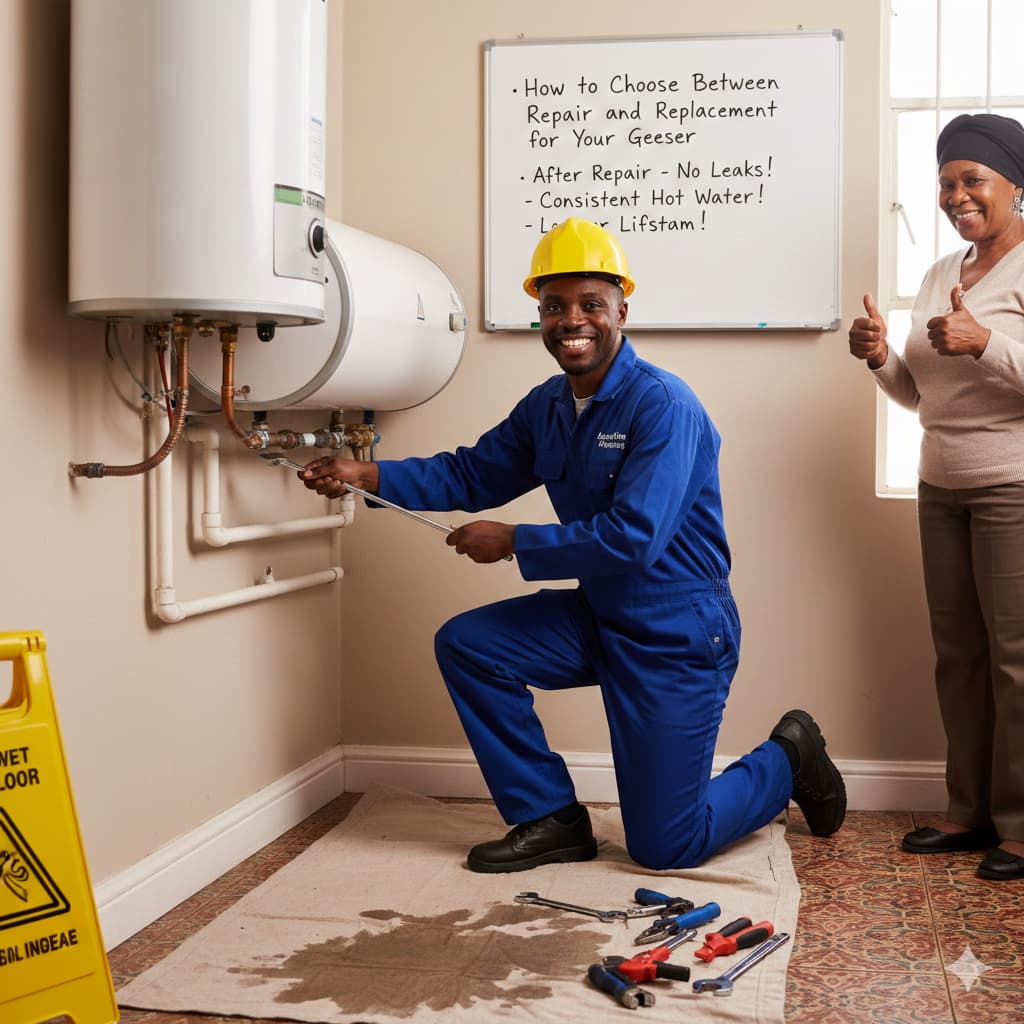
How to Choose Between Repair and Replacement for Your Geyser
Deciding between repairing and replacing isn't just about the immediate price tag. It is about safety, long-term electricity savings, and compliance with South African building regulations. Based on insights from vetted plumbers across Johannesburg, Cape Town, and Durban, this guide will help you navigate that decision with confidence.

There is very little that ruins a morning faster than turning on the shower tap and getting hit with ice-cold water. In South Africa, where we already deal with load shedding schedules impacting our hot water, a broken geyser adds a layer of stress that no homeowner needs.
When you are standing there shivering, the immediate panic is usually financial. Do you just need a quick fix, or is this the end of the road for your geyser?
Making the call between repairing and replacing isn't just about the immediate price tag. It is about safety, long-term electricity savings, and compliance with South African building regulations. Based on insights from vetted plumbers across Johannesburg, Cape Town, and Durban, this guide will help you navigate that decision with confidence.
The 50% Rule: A Quick Rule of Thumb
Before we dive into the technical details, here is a golden rule many honest plumbers use: The 50% Rule.
If the cost of the repair is more than 50% of the cost of a brand-new geyser (installation included), you should generally replace it.
However, in the South African context, "installation included" is the tricky part. A replacement isn't just buying a new white tank; it involves bringing your plumbing up to the current SANS 10254 code. This often makes replacement more expensive than homeowners anticipate, but it is necessary for your insurance validity.
When to Repair: The "Electricals" and Minor Leaks
A geyser is a simple system: a big tank that holds water and electrical components that heat it. Often, the tank is fine, but the components have failed. These are the scenarios where repair is almost always the smarter financial move.
1. The Water is Cold (Thermostat or Element Failure)
If your geyser isn't leaking but the water is cold, 90% of the time it is a faulty thermostat or heating element.
- The Fix: A plumber drains the geyser and replaces the element or thermostat.
- The Cost: This is a standard repair. Depending on the brand (Kwikot, Heat Tech, etc.) and the kilowatt rating of the element, this typically ranges between R1,200 and R2,500 including labour.
- Expert Insight: "In areas with hard water, like parts of the Northern Cape or Gauteng, limescale builds up on the element, causing it to burn out faster," notes Thomas, a vetted plumber from Randburg. "If your tank is only 4 years old, just replace the element. It’s not worth buying a whole new unit."
2. Leaking from the Valves
If you see water dripping from the safety valve (the TP valve) or the vacuum breakers (the brass components on the pipes above the geyser), this is usually a localized repair.
- The Fix: Replacing the specific faulty valve.
- The Note: Sometimes a dripping TP valve actually means the thermostat is stuck "on" and the water is overheating, causing the valve to open as a safety measure. A qualified plumber will check both.
3. Tripping Electricity
If your earth leakage trips the moment the geyser switches on, the element has likely ruptured, exposing the live wire to water. This is a clear-cut repair job, provided the tank itself isn't rusted.
When to Replace: Structural Failure and Age
There are times when spending money on a repair is just throwing good money after bad. Here is when you need to bite the bullet and replace the unit.
1. The Tank has Burst (Cylinder Failure)
If water is pouring out of the ceiling or the body of the geyser itself is dripping, the inner cylinder has ruptured. There is no patching this.
- The Reality: The inner lining (glass-lined or copper) has failed. You need a new unit immediately to prevent water damage to your ceilings and cupboards.
2. The Geyser is Over 10 Years Old
Geysers in South Africa generally have a lifespan of 8 to 12 years. If your 12-year-old geyser blows an element, think twice before fixing it.
- Why? The insulation inside old geysers degrades, causing them to lose heat faster and use more electricity.
- The efficiency factor: Modern Class B energy-rated geysers retain heat much better than the older units. Replacing an old unit can actually lower your monthly Eskom bill.
3. Visible Rust on the Exterior
If you climb into the roof and see deep rust stains on the outside casing or around the seams, a burst is imminent. It is better to replace it on your own terms (scheduled) than as an emergency (at 2 am on a Sunday).
The "Hidden" Costs of Replacement in SA
This is where many homeowners get caught out. You might see a 150L geyser advertised at a hardware store for R4,500 and think that is the total cost.
However, under SANS 10254 regulations, a plumber cannot simply swap an old geyser for a new one without ensuring the entire installation is compliant. If your old geyser was installed in 2005, the laws have changed significantly since then.
A compliant installation now requires:
- A Drip Tray: With a drain pipe piped to the exterior (so if it bursts, your ceiling is safe).
- Vacuum Breakers: Installed at specific heights on both hot and cold lines to prevent siphoning.
- Structural Support: The timber passing must support the weight of a full geyser (approx. 180kg for a 150 L unit).
Mrs. Naidoo in Durban wanted to replace her old geyser. The unit cost R4,500, but because her old installation had no drip tray and illegal piping, the labour and additional materials brought the total to around R8,500. While this was a shock, it meant her insurance would actually pay out if anything went wrong in the future—something they would have rejected with a "cheap" non-compliant swap.
Tip: Always ask your plumber for a COC (Certificate of Compliance) after a replacement. Your insurance provider will likely demand this if you ever claim for water damage.
Decision Checklist: Repair vs. Replace
Use this quick checklist to make your final decision.
Choose REPAIR if:
- The geyser is less than 5–7 years old.
- The tank itself is dry; the leak is only coming from a valve or connection pipe.
- The issue is purely electrical (cold water or tripping power).
- You are planning to renovate or move in the next 6 months (short-term fix).
Choose REPLACE if:
- The unit is over 10 years old.
- The water is leaking from the body of the cylinder.
- The water is brown or rusty (indicates internal corrosion).
- You want to improve energy efficiency or switch to a solar-ready geyser.
- The cost of the repair part is more than 50% of a new installation.
Frequently Asked Questions
Does my building insurance cover a burst geyser?
In most cases, yes. Standard building insurance usually covers the replacement of the geyser itself and the resultant water damage (like ruined ceilings). However, they often do not cover the "betterment" costs—meaning if your plumbing needs to be upgraded to meet current SANS regulations (like adding a drip tray that wasn't there before), you might have to pay the difference. Always check your specific policy.
Can I replace a geyser element myself?
Technically, you might be able to do it physically, but legally and safely, you should not. A geyser involves both high-voltage electricity and water pressure. Incorrect installation can lead to electrocution or a steam explosion. Furthermore, doing it yourself voids the manufacturer's warranty and your home insurance.
How much does a geyser replacement cost in South Africa?
For a standard 150L geyser replacement, you are looking at a price range of R6,500 to R9,500. This wide range depends on whether the plumber needs to add new valves, drip trays, and piping to ensure the installation is compliant with current laws. A simple "swap" where the infrastructure is already perfect will be on the lower end.
Read our guide on geyser installation costs in South Africa.
How long does a geyser usually last?
On the coast, where the air is salty and the humidity is high, geysers often last about 5 to 8 years. Inland, in places like Johannesburg, they can last 10 to 15 years. Regular maintenance, like replacing the sacrificial anode every 2 years, can significantly extend this lifespan.
Suzette Meyer is the lead author and content creator for Kandua.com, South Africa’s #1 marketplace for home services. Suzette has made it her mission to help homeowners with advice on all aspects of home repair, maintenance and improvement, including how to choose the right Pro and how to make smart upgrades that improve your resale value or save costs.

Latest articles, advice and more
.webp)
.webp)
.jpeg)
Sinking Pavers, Weeds and Water That Pools: What Your Driveway Is Telling You
When your driveway starts sprouting weeds, pooling water, or sinking in patches, the bricks are not failing you. The layers underneath have moved, and they are trying to tell you exactly what went wrong.
.jpeg)
What Your Garage Door Motor Actually Does (And Why It Breaks)
Spoiler alert: your garage door motor isn't actually doing the heavy lifting. The torsion springs carry almost all the weight. The motor simply pushes, pulls, controls the descent so it doesn't slam, and acts as a lock when the door is shut. That’s why a relatively small box on your ceiling can move such a massive door. Want to test this? Pull the red manual release cord and lift the door by hand. If it glides up easily and stays put when you let go, your springs are doing their job, and the fault lies with the motor. If the door feels like dead weight or slams back down- stop. You’ve got a spring problem.
.jpeg)
4 Warning Signs Your Tiles Are Failing (And What They Mean)
Tiles rarely fail overnight. They warn you first. A hollow sound underfoot, grout that crumbles away, a tile that lifts at one edge, or a crack that runs across two tiles all point to something happening under the surface. Here is what each sign means, and how urgent it is.
.webp)
.webp)
Beyond the Unboxing: A Detailed Guide to Correct Washing Machine Plumbing & Setup
New washing machine in South Africa? Learn essential plumbing and setup tips to prevent leaks, ensure efficient operation, and extend your appliance’s lifespan - expert advice before your first load.
.webp)
New Washing Machine? Don't Plug It In Yet! Essential Installation Tips for SA Homes
Installing a new washing machine? Learn the essential setup steps South African homeowners often overlook to prevent leaks, noise, and damage—and ensure efficient, long-lasting performance from day one.
.webp)
.webp)
%25201200%2520x%25201200%2520(1).jpeg)
What Retiling a Bathroom Costs in 2026, Room by Room
Retiling a bathroom in South Africa costs between R230 and R800 per square metre in 2026, including materials and labour. A standard family bathroom, stripped and fully retiled, usually lands between R11,800 and R27,500. A guest toilet costs a fraction of that. A large porcelain en-suite costs a lot more.
How to Install a Horizontal Geyser | Step-by-Step Pro Guide
Want to install a geyser like a pro? This step-by-step tutorial shows you exactly how to do a horizontal Ariston Axios geyser installation, straight from the BluLever plumbing workshop. 🎥 Hosted by MK, BluLever’s technical facilitator, and supported by a qualified electrician, Life and a BluLever graduate artisan, Zinhle. This is your ultimate guide to a SANS 10254-compliant installation — from preparing the wall, to plumbing, electrical wiring, and pro troubleshooting tips.
How to Maintain a Geyser | Step-by-Step Pro Guide
Want to maintain a geyser like a pro? This step-by-step tutorial shows you exactly how to do the three core geyser maintenance checks on an Ariston Axios geyser installation, straight from the BluLever plumbing workshop. 🎥 Hosted by MK, BluLever’s technical facilitator, and supported by a qualified electrician, Life. This is your ultimate guide to geyser maintenance — from diagnosing the problem to checking the heat regulation of the geyser, to pressure regulation and then finally corrosion protection.
%201.avif)
Not just another newsletter. It's an advantage