
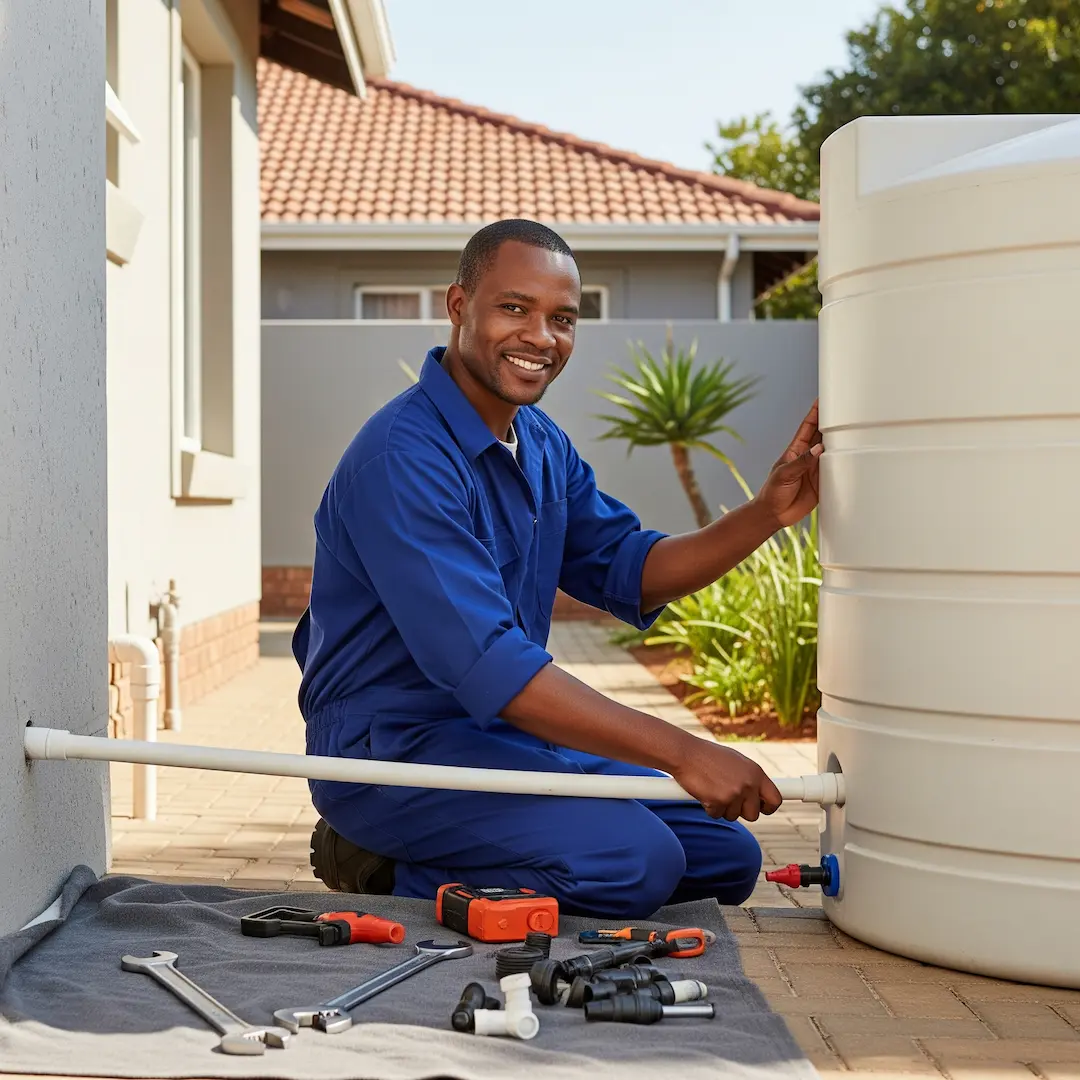
Choosing the Right Water Backup Tank for Load Shedding: Size, Type & Placement
Choosing a water backup tank in South Africa? Learn how to select the right size, material, and placement to stay water-secure during load shedding and supply interruptions.

Load shedding has become a persistent challenge for South African homeowners, disrupting daily routines and highlighting the critical need for reliable backup systems. When it comes to water, having a dedicated backup tank can provide peace of mind and ensure your household continues to function even when the municipal supply falters. But with so many options available, how do you choose the right one? This guide will walk you through the essential considerations: tank size, material, and optimal placement, drawing on insights from experienced plumbers across the country.
Calculating the Right Water Tank Size for Your Home
One of the most common questions homeowners ask is, "What size water tank do I need for my home?" The answer isn't a one-size-fits-all, as it depends heavily on your household's unique water consumption patterns and how long you want your backup supply to last during an outage.
Our expert plumbers often advise starting with a calculation of your average daily water usage. A good rule of thumb for South African households is to estimate around 50 to 100 litres of water per person per day for essential activities like drinking, cooking, basic hygiene, and flushing toilets. This can vary significantly based on habits – for example, long showers or frequent laundry cycles will increase this figure.
Here's how to break it down:
- Determine Household Occupancy: How many people live in your home?
- Estimate Daily Consumption Per Person: Consider your family's habits. Are you water-conscious, or do you have high-usage appliances?
- Expert Tip: One plumber recounted a client who initially thought a 1000L tank would suffice for their family of four. After a detailed discussion about their two teenagers' lengthy showers and daily machine washes, they quickly realised they needed at least a 2500L tank to cover just a two-day outage comfortably. It’s better to overestimate slightly than to run dry.
- Decide on Backup Duration: How many days of backup water do you want to store? For typical load shedding scenarios, many South Africans aim for 2 to 3 days. For more extended outages or if you're in an area with frequent water interruptions, you might consider 5 to 7 days.
Calculation Example:
Let's say you have a household of 4 people, and you aim for 75 litres per person per day for essential use, and you want a 3-day backup:
- Daily consumption: 4 people * 75 litres/person = 300 litres/day
- Required tank size for 3 days: 300 litres/day * 3 days = 900 litres
In this scenario, a 1000-litre tank would be a good starting point, providing a little extra buffer. For larger families or those with higher consumption, tanks of 2500L, 5000L, or even larger might be necessary. It’s always best to consult with a qualified plumber who can assess your specific needs and provide an accurate recommendation.
Best Water Tank for Backup: Polyethylene vs. Steel
When it comes to water tank materials in South Africa, polyethylene (plastic) and steel are the most common choices, each with distinct advantages and disadvantages.
Polyethylene (Plastic) Tanks
Polyethylene tanks are widely popular, and for good reason. They are typically roto-moulded, meaning they have no seams, which reduces the risk of leaks.
- Pros:Cost-Effective: Generally more affordable upfront than steel tanks, especially for smaller to medium capacities.
- Lightweight: Easier to transport and install, making them suitable for various residential applications.
- Corrosion-Resistant: Plastic doesn't rust, making it ideal for storing water over long periods without concerns about material degradation.
- UV Stabilised: Good quality polyethylene tanks are UV-stabilised to withstand the harsh South African sun, preventing material breakdown and algae growth inside the tank (often achieved with a black internal layer).
- Variety: Available in a wide range of sizes, shapes (including slimline options for tight spaces), and colours.
- Cons:Limited Very Large Capacities: While large plastic tanks exist, steel often becomes more cost-effective for capacities exceeding 20,000 litres.
- Susceptible to Damage: Can be more prone to impact damage than steel, though modern tanks are designed for rigidity.
- Experience Insight: A plumber once shared how a client's plastic tank, installed too close to a high-traffic area, developed a small crack after being bumped repeatedly by garden equipment. This highlights the importance of thoughtful placement and protection.
Steel Tanks
Steel tanks, while a larger initial investment, offer robust durability and are particularly suited for substantial water storage.
- Pros:Exceptional Durability: With a lifespan often exceeding 20-30 years, steel tanks are incredibly resilient to environmental factors and impacts.
- Large Capacity Options: Ideal for very large-scale water storage, often seen in agricultural or industrial settings, but also suitable for large residential properties.
- Algae Prevention: Fully enclosed steel tanks effectively block out light, preventing algae growth without the need for internal lining.
- Recyclable: Steel is a highly recyclable material, making it an environmentally friendly choice.
- Cons:Higher Initial Cost: The upfront investment is generally higher than for polyethylene tanks.
- Weight: Heavier than plastic, requiring more robust foundations and potentially more complex installation.
- Corrosion Risk: Unless properly treated and maintained, steel can be susceptible to rust, especially with certain water qualities.
- Authoritative Perspective: According to industry standards, proper internal lining or galvanisation is crucial for steel tanks storing potable water to prevent contamination and extend lifespan. Installers adhere to strict guidelines to ensure water quality is maintained.
For most South African homes looking for a water backup solution for load shedding, a good quality polyethylene tank often strikes the best balance between cost, ease of installation, and sufficient capacity. However, if you require very large volumes or extreme durability, steel might be the superior choice.
Ideal Placement for Your Water Backup Tank: Gravity Feed vs. Pump Systems
The placement of your water backup tank is crucial, impacting both its functionality and the overall efficiency of your water supply during outages. You essentially have two primary options: a gravity feed system or a pump-driven system.
Gravity Feed System
A gravity feed system relies on the natural force of gravity to deliver water from your tank to your taps.
- How it works: The tank is installed at a higher elevation than the points of use (e.g., on a elevated tank stand or a natural high point on your property like a hillside). When needed, water flows downwards through pipes due to gravity, providing pressure.
- Pros:No Electricity Needed: This is the significant advantage during load shedding – water will flow without power.
- Simple Operation: Fewer mechanical parts means less to go wrong.
- Quiet: No pump noise.
- Cons:Limited Pressure: The pressure delivered is directly proportional to the height difference between the tank and the tap. For sufficient domestic pressure (around 2.5 Bar), a tank stand would need to be approximately 25 metres high, which is rarely practical or aesthetically pleasing for a residential setup. This means gravity feed often results in lower pressure, impacting shower performance or appliance function.
- Complex Installation for Height: Erecting a sufficiently high, stable tank stand capable of holding thousands of litres of water (1000 litres of water weighs 1 metric tonne) requires significant engineering, costly materials, and professional installation.
- Expert Opinion: Many plumbers will tell you that while the idea of a completely off-grid gravity system is appealing, in practice, achieving usable pressure for a modern home without a pump is incredibly challenging and often prohibitively expensive. They've seen countless instances where homeowners thought a 2-meter stand would be enough, only to find their shower barely trickled.
Pump-Driven System
A pump-driven system uses an electric pump to pressurise and deliver water from your tank.
- How it works: The water tank is typically installed at ground level, often out of sight. When the municipal supply is interrupted, a pump (connected to your backup power system like an inverter, solar, or generator) draws water from the tank and pushes it through your home's plumbing at a consistent pressure.
- Pros:Consistent Pressure: Delivers water at a steady, reliable pressure, similar to your normal municipal supply, ensuring all appliances and taps function optimally.
- Flexible Placement: Tanks can be placed at ground level, often in less conspicuous locations, making installation easier and more aesthetically pleasing.
- Scalability: Easier to integrate into existing plumbing systems and expand with additional tanks if needed.
- Cons:Requires Power: The pump needs electricity to operate. This means you'll need a backup power solution (inverter, solar, generator) to run the pump during load shedding.
- Pump Noise: Pumps can generate some noise, although modern units are often designed to be quieter.
- Maintenance: Pumps require occasional maintenance to ensure optimal performance.
- Authoritativeness: Modern pump technology, coupled with efficient backup power solutions, has made ground-level, pump-driven water backup systems the preferred choice for most urban and suburban South African homes. They adhere to SANS standards for water supply installations, ensuring safety and efficiency.
Recommended Placement Strategies:
- Ground-Level for Pump Systems: For most residential properties, installing the tank on a flat, stable concrete slab at ground level is the most practical and cost-effective approach. Ensure it's easily accessible for maintenance but out of the way of daily activities. Many homeowners opt to place them against a wall, behind a shed, or even underground if local regulations allow.
- Near Main Water Inlet: Positioning the tank close to your home's main water inlet simplifies plumbing connections.
- Protection from Elements: While polyethylene tanks are UV-stabilised, prolonged exposure to extreme sun or physical damage can still occur. Consider placing the tank in a shaded area or building a simple enclosure around it. This also helps keep the water cooler, inhibiting algae growth.
Ultimately, the best water backup tank setup for your home will be a pump-driven system with a ground-level tank. This provides the most practical, reliable, and comfortable solution for navigating South Africa's load shedding challenges. Always engage a qualified plumber to assess your property and provide professional installation to ensure your system is safe, compliant, and performs as expected.
Frequently Asked Questions
Can I connect my water backup tank directly to my house's main water supply?
Yes, a qualified plumber can connect your backup tank to your home's main water supply. This typically involves installing a bypass system with non-return valves to prevent backflow into the municipal lines and a pump (for ground-level tanks) to pressurise the water for distribution throughout your home. This ensures that when municipal water is off, your tank seamlessly takes over.
How do I prevent algae growth in my water backup tank?
Algae requires light to grow. High-quality polyethylene tanks often have an opaque, dark inner layer that blocks light penetration. Steel tanks, being completely opaque, are naturally resistant to algae. Additionally, ensure your tank is always sealed with a tight-fitting lid to prevent light entry and airborne contaminants. Regular use and flushing of the tank also help prevent stagnation.
What maintenance does a water backup tank system require?
Generally, water backup tanks themselves require minimal maintenance – mainly ensuring the lid is secure and checking for any leaks. If you have a pump, regular maintenance will involve checking the pump's operation, pressure settings, and ensuring any filters are clean. It's advisable to have your system inspected annually by a qualified plumber to ensure all components are functioning correctly and that water quality is maintained.
Is it safe to drink water from a backup tank?
If your backup tank is filled with municipal tap water, and the tank itself is food-grade and regularly maintained, the water should be safe for drinking. Many tanks are specifically certified for potable water storage (check for SANS 1731:2017 compliance). However, if you're collecting rainwater or borehole water, it's highly recommended to install a proper filtration and purification system for drinking water purposes to ensure it meets health standards.
Find a vetted plumber near you
Water tanks and backup systems: find a pro near you
- Water tanks and backup systems near you
- Water tanks and backup systems in Johannesburg
- Water tanks and backup systems in Sandton
- Water tanks and backup systems in Midrand
- Water tanks and backup systems in Roodepoort
- Water tanks and backup systems in Randburg
- Water tanks and backup systems in Pretoria
- Water tanks and backup systems in Cape Town
Suzette Meyer is the lead author and content creator for Kandua.com, South Africa’s #1 marketplace for home services. Suzette has made it her mission to help homeowners with advice on all aspects of home repair, maintenance and improvement, including how to choose the right Pro and how to make smart upgrades that improve your resale value or save costs.

Latest articles, advice and more
.webp)
.webp)
.webp)
.webp)
.jpeg)
Sinking Pavers, Weeds and Water That Pools: What Your Driveway Is Telling You
When your driveway starts sprouting weeds, pooling water, or sinking in patches, the bricks are not failing you. The layers underneath have moved, and they are trying to tell you exactly what went wrong.
.webp)
.webp)
Beyond the Unboxing: A Detailed Guide to Correct Washing Machine Plumbing & Setup
New washing machine in South Africa? Learn essential plumbing and setup tips to prevent leaks, ensure efficient operation, and extend your appliance’s lifespan - expert advice before your first load.
.webp)
New Washing Machine? Don't Plug It In Yet! Essential Installation Tips for SA Homes
Installing a new washing machine? Learn the essential setup steps South African homeowners often overlook to prevent leaks, noise, and damage—and ensure efficient, long-lasting performance from day one.
.webp)
.webp)
%25201200%2520x%25201200%2520(1).jpeg)
What Retiling a Bathroom Costs in 2026, Room by Room
Retiling a bathroom in South Africa costs between R230 and R800 per square metre in 2026, including materials and labour. A standard family bathroom, stripped and fully retiled, usually lands between R11,800 and R27,500. A guest toilet costs a fraction of that. A large porcelain en-suite costs a lot more.
How to Install a Horizontal Geyser | Step-by-Step Pro Guide
Want to install a geyser like a pro? This step-by-step tutorial shows you exactly how to do a horizontal Ariston Axios geyser installation, straight from the BluLever plumbing workshop. 🎥 Hosted by MK, BluLever’s technical facilitator, and supported by a qualified electrician, Life and a BluLever graduate artisan, Zinhle. This is your ultimate guide to a SANS 10254-compliant installation — from preparing the wall, to plumbing, electrical wiring, and pro troubleshooting tips.
How to Maintain a Geyser | Step-by-Step Pro Guide
Want to maintain a geyser like a pro? This step-by-step tutorial shows you exactly how to do the three core geyser maintenance checks on an Ariston Axios geyser installation, straight from the BluLever plumbing workshop. 🎥 Hosted by MK, BluLever’s technical facilitator, and supported by a qualified electrician, Life. This is your ultimate guide to geyser maintenance — from diagnosing the problem to checking the heat regulation of the geyser, to pressure regulation and then finally corrosion protection.
%201.avif)
Not just another newsletter. It's an advantage