
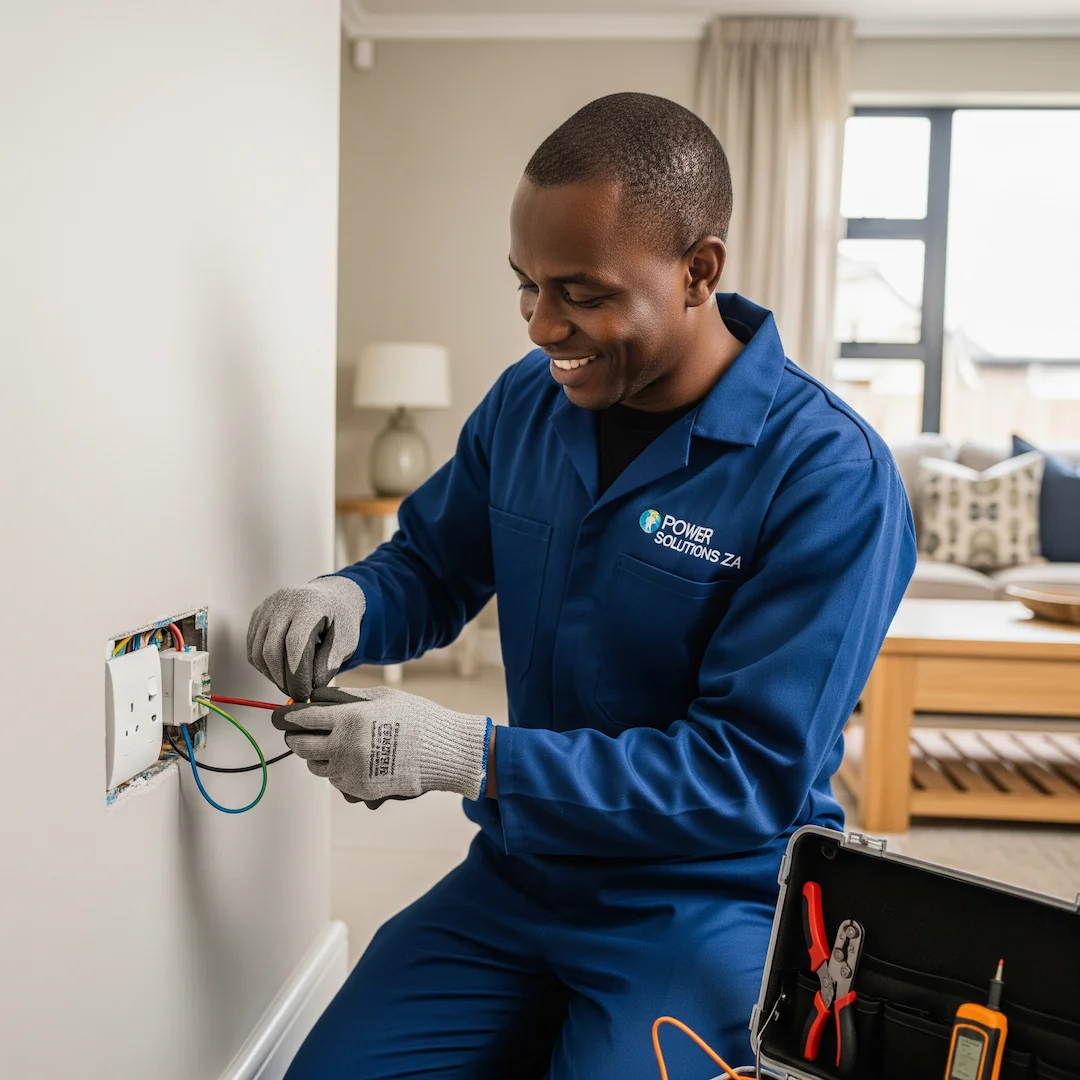
Adding Electrical Outlets in Your SA Home: Investing in Convenience and Safety with Professional Installation
Need more plug points? Learn why professional installation is essential for safely adding electrical outlets in South African homes - boosting convenience without risking faults or hazards.

Adding Electrical Outlets in Your SA Home: Investing in Convenience and Safety with Professional Installation
It’s a familiar story in many South African homes. The kettle, toaster, and air fryer are all vying for the same double plug point. You’re running a multi-plug extension cord from the lounge to your new work-from-home desk, creating a daily trip hazard. The simple fact is, modern life demands more power points than our homes were often built with. While the temptation to simply add another outlet yourself might seem like a quick and cheap fix, it’s a decision that carries significant risks.
Adding a new electrical outlet isn't just about connecting a few wires. It's about safely integrating a new point of demand into a complex, existing system. Getting it wrong can have consequences far more severe than a flickering light. This is where the value of a professional electrician becomes crystal clear—transforming a potentially hazardous DIY project into a safe, compliant, and convenient upgrade for your home.
The Problem with "Temporary" Solutions
Before we dive into the technical side, let's talk about the go-to fix for many: the extension cord and multi-plug adapter. While useful for short-term needs, relying on them permanently is a bad idea.
- Fire Hazard: Most consumer-grade extension cords are not designed for high-power, long-term use. One of our vetted electricians recently shared a story from a call-out in a Johannesburg suburb. A family had been running their new dishwasher and washing machine off a single extension cord hidden behind the appliances. The cord, unable to handle the combined load, had slowly melted its insulation over weeks, eventually causing a short circuit that thankfully only tripped the breaker but could easily have started a fire.
- Appliance Damage: Unstable power delivery from overloaded adapters can damage the sensitive electronics in your expensive appliances, from your smart TV to your microwave.
- They Aren't a Real Solution: Ultimately, extension cords are clumsy, unsightly, and a constant reminder that your home’s electrical layout isn’t meeting your needs.
A professionally installed outlet is a permanent, safe, and elegant solution that adds real value and functionality to your living space.
The Hidden Dangers of DIY Electrical Work
Tackling a home improvement project yourself can be incredibly rewarding, but electrical work is one area where the risks far outweigh the benefits of saving a few Rand. Here’s what can go wrong when you try to install an outlet without the proper knowledge and tools.
Disclaimer: This information is for educational purposes only. Electrical work is dangerous. Always hire a qualified and registered electrician for any installations, repairs, or modifications to your home's electrical system.
Misunderstanding Your Home’s Electrical System
Your home’s wiring is more than just a collection of cables; it’s a balanced system. Each circuit is protected by a circuit breaker in your distribution board (DB board) that is rated for a specific maximum current (amperage).
Imagine a circuit is like a road, and the electricity is the traffic. The circuit breaker is the boom gate that shuts down the road if the traffic gets too heavy, preventing a "traffic jam" (overload) that could cause major problems. If you add a new outlet to a circuit that is already close to its maximum capacity—like the kitchen circuit that already powers a fridge, microwave, and kettle—you risk causing a constant overload. This leads to frustrating, frequent tripping of the breaker or, in a worst-case scenario, the breaker failing and the wires overheating.
The Risk of Incorrect Wiring
A plug point has three critical connections: live, neutral, and earth. A simple mistake here can have immediate and dangerous consequences.
- Reversed Polarity: Connecting the live and neutral wires the wrong way around can cause some appliances to remain electrically live even when switched off, creating a serious shock hazard.
- Loose Connections: This is one of the most common causes of electrical fires. If a wire isn't secured tightly in the terminal, it can create tiny electrical arcs. This arcing generates intense heat, which can melt the plastic housing of the outlet and ignite nearby materials like wooden skirting boards or drywall.
- Poor Earthing: The earth wire is a crucial safety feature. It provides a path for electricity to travel safely to the ground in the event of a fault, causing the breaker to trip instantly. An improperly connected or non-existent earth wire means a faulty appliance's metal casing could become live, waiting to deliver a severe electric shock to the next person who touches it.
SANS 10142-1 Compliance is Not a Suggestion
In South Africa, all fixed electrical installations must comply with the SANS 10142-1 wiring code. These regulations are in place for one reason: to keep you safe. A professional electrician understands these standards inside and out.
Compliance isn't just about safety; it's also about legality and insurance. If an electrical fire occurs and it's found that the cause was non-compliant DIY work, your insurance company may have grounds to refuse your claim. Furthermore, when you sell your home, you are required by law to provide a valid Electrical Certificate of Compliance (CoC). Any unauthorised work will be flagged during the inspection, requiring you to pay a professional to fix it anyway.
What a Professional Electrician Does Differently
When you hire a qualified electrician, you're not just paying for a pair of hands; you're investing in expertise, safety, and peace of mind. Here’s a glimpse into the professional process.
- Assessment and Planning: A good electrician won't just start cutting into your wall. They will first inspect your DB board and identify the existing circuits. They will calculate the current load on the circuit where you want to add the outlet to ensure it can handle the extra demand. If not, they will advise on the best course of action, which might involve running a new, dedicated circuit directly from the DB board.
- Using the Correct, SABS-Approved Materials: From the gauge (thickness) of the wire to the type of conduit used to protect it inside the wall, every component matters. Professionals use SABS-approved materials that are designed to meet safety standards for heat resistance and durability.
- Safe and Compliant Installation: The process is meticulous. This may involve chasing a channel into the wall, installing a flush-mount box, running the wiring through protective conduit, and ensuring every connection is mechanically and electrically sound. They work to ensure the final installation is not only safe but also neat and professional-looking.
- Testing and Certification: After the installation, the electrician will use specialised equipment to test the circuit. They check for correct polarity, earth continuity, and insulation resistance to confirm everything is working safely. For new circuits or significant alterations, they will issue a new or supplementary Electrical Certificate of Compliance (CoC), giving you documented proof that the work was done to the required legal standard.
Investing in a professional to add new outlets is an investment in the long-term safety of your family, the protection of your appliances, and the overall value of your property. It’s the smart choice that turns the desire for more convenience into a reality, without compromise.
Frequently Asked Questions
How long does it typically take to install a new electrical outlet?
For a straightforward installation on an existing circuit where the wiring is accessible (e.g., in a wall cavity or surface-mounted trunking), it can take a qualified electrician 1 to 2 hours. If a new channel needs to be cut into a brick wall ("chasing"), replastered, and a new circuit run from the DB board, it could take the better part of a day.
Can a new electrical outlet be installed on any wall?
Technically, an outlet can be installed on almost any interior or exterior wall. However, the complexity and cost can vary. Installing on a solid brick wall requires chasing, while a drywall installation might be simpler. Proximity to water sources, like in kitchens and bathrooms, requires specific types of outlets and placement according to SANS regulations to prevent shock hazards.
What's the difference between adding to an existing circuit and running a dedicated circuit?
Adding to an existing circuit means "tapping into" the power from a nearby outlet. This is suitable for low-power uses. A dedicated circuit is a brand-new wire run directly from your DB board, with its own circuit breaker, intended for a single, high-power appliance like an oven, a geyser, or an air conditioner. This ensures the appliance has all the power it needs without overloading other parts of your home's electrical system.
Do I need a new Certificate of Compliance (CoC) for just one new plug point?
According to SANS 10142-1, any alteration or addition to an existing electrical installation requires the issuing of a supplementary CoC for that specific work. This document is then kept with the original CoC for the property. This ensures there is a paper trail of certified, safe work being done on your home over time.

Latest articles, advice and more
.webp)
.jpg)
Sinking Pavers, Weeds and Water That Pools: What Your Driveway Is Telling You
When your driveway starts sprouting weeds, pooling water, or sinking in patches, the bricks are not failing you. The layers underneath have moved, and they are trying to tell you exactly what went wrong.
.jpg)
What Your Garage Door Motor Actually Does (And Why It Breaks)
Spoiler alert: your garage door motor isn't actually doing the heavy lifting. The torsion springs carry almost all the weight. The motor simply pushes, pulls, controls the descent so it doesn't slam, and acts as a lock when the door is shut. That’s why a relatively small box on your ceiling can move such a massive door. Want to test this? Pull the red manual release cord and lift the door by hand. If it glides up easily and stays put when you let go, your springs are doing their job, and the fault lies with the motor. If the door feels like dead weight or slams back down- stop. You’ve got a spring problem.
.jpg)
4 Warning Signs Your Tiles Are Failing (And What They Mean)
Tiles rarely fail overnight. They warn you first. A hollow sound underfoot, grout that crumbles away, a tile that lifts at one edge, or a crack that runs across two tiles all point to something happening under the surface. Here is what each sign means, and how urgent it is.
.jpg)
Braai Area Rust, Cracked Paint And Dodgy Outdoor Plugs: The Heritage Day Checklist
Braai area maintenance before Heritage Day comes down to three jobs: strip and treat rust on the braai stand and steel fittings, repair cracked or flaking exterior paint, and have a qualified electrician check every outdoor plug and light. Start two weeks out so coatings have time to cure properly.
.webp)
.webp)
Beyond the Unboxing: A Detailed Guide to Correct Washing Machine Plumbing & Setup
New washing machine in South Africa? Learn essential plumbing and setup tips to prevent leaks, ensure efficient operation, and extend your appliance’s lifespan - expert advice before your first load.
.webp)
New Washing Machine? Don't Plug It In Yet! Essential Installation Tips for SA Homes
Installing a new washing machine? Learn the essential setup steps South African homeowners often overlook to prevent leaks, noise, and damage—and ensure efficient, long-lasting performance from day one.
.webp)
%201200%20x%201200%20(1).jpg)
What Retiling a Bathroom Costs in 2026, Room by Room
Retiling a bathroom in South Africa costs between R230 and R800 per square metre in 2026, including materials and labour. A standard family bathroom, stripped and fully retiled, usually lands between R11,800 and R27,500. A guest toilet costs a fraction of that. A large porcelain en-suite costs a lot more.
.webp)
TV Repair Costs in South Africa: Diagnosing Screen, Power & Component Issues
Find out what TV repairs really cost in South Africa – from call-out and diagnosis fees to screen, power and main board fixes – and when it’s cheaper to replace your TV instead of repairing it.
How to Install a Horizontal Geyser | Step-by-Step Pro Guide
Want to install a geyser like a pro? This step-by-step tutorial shows you exactly how to do a horizontal Ariston Axios geyser installation, straight from the BluLever plumbing workshop. 🎥 Hosted by MK, BluLever’s technical facilitator, and supported by a qualified electrician, Life and a BluLever graduate artisan, Zinhle. This is your ultimate guide to a SANS 10254-compliant installation — from preparing the wall, to plumbing, electrical wiring, and pro troubleshooting tips.
How to Maintain a Geyser | Step-by-Step Pro Guide
Want to maintain a geyser like a pro? This step-by-step tutorial shows you exactly how to do the three core geyser maintenance checks on an Ariston Axios geyser installation, straight from the BluLever plumbing workshop. 🎥 Hosted by MK, BluLever’s technical facilitator, and supported by a qualified electrician, Life. This is your ultimate guide to geyser maintenance — from diagnosing the problem to checking the heat regulation of the geyser, to pressure regulation and then finally corrosion protection.
%201.avif)
Not just another newsletter. It's an advantage