
Designing Your Solar Future in SA: Why Expert Consultation is Your First Step to Energy Independence
Planning solar for your South African home? Learn why expert system design and consultation are essential first steps to ensure energy independence, maximise savings, and avoid costly mistakes.

Designing Your Solar Future in SA: Why Expert Consultation is Your First Step to Energy Independence
The hum of the generator, the scramble for candles, the frustration of another evening plunged into darkness—it’s a story every South African knows well. As load shedding persists and electricity tariffs climb ever higher, more homeowners are looking to the sun for a solution. Solar power promises energy independence, lower bills, and a more sustainable lifestyle. But a successful solar journey doesn't begin with buying panels online or chasing the cheapest "all-in-one" kit. It starts with a conversation and a plan.
The single most critical step to unlocking the true value of solar energy is a professional design and consultation. This foundational stage ensures your system is not just a collection of hardware on your roof, but a tailored energy solution built specifically for your home, your family, and your future. Rushing this step is the most common—and costly—mistake a homeowner can make.
Why a Professional Solar Design is Non-Negotiable
Think of building a house. You wouldn't just buy a pile of bricks and start laying them without a blueprint, would you? A solar installation is no different. It's a significant investment in your home's infrastructure, and the "blueprint" is the professional design.
One of our top-rated solar installers recently shared a story that perfectly illustrates this. A homeowner in Johannesburg, tired of load shedding, bought a "complete solar kit" from an online retailer. It seemed like a great deal. However, after installation, they found the system couldn't even last through a two-hour blackout if the geyser was on. The inverter was too small for their peak demand, and the battery bank was woefully undersized for their evening energy use. They ended up spending thousands more to replace the core components, effectively paying twice. This expensive lesson could have been avoided with an initial expert consultation.
A professional design goes far beyond a simple quote. It’s a comprehensive analysis that includes:
- A Deep Dive into Your Energy Consumption: A true expert won't just glance at your municipal bill. They will analyse your usage patterns. When do you use the most electricity? Is it the morning rush with the kettle, toaster, and geyser? Or the evening with the stove, TV, and lights? They’ll help you identify your peak loads and your base load (the energy you use 24/7, like the fridge and security systems). This detailed analysis is the bedrock of a correctly sized system.
- A Thorough Site Assessment: Every roof is different. An expert will conduct a detailed site visit to assess:
- Roof Orientation and Pitch: In the Southern Hemisphere, a north-facing roof is ideal for maximum sun exposure throughout the day. The angle (pitch) of the roof also affects performance.
- Shading Analysis: That lovely Jacaranda tree or your neighbour's new double-storey extension can cast shadows on your roof at certain times of the day or year. Even partial shading on a single panel can significantly reduce the output of your entire system. A consultant uses specialised tools to map this shading and plan the panel layout accordingly.
- Structural Integrity: Is your roof strong enough to support the weight of the panels, especially in high-wind areas like the Western Cape coast? A professional assessment ensures the installation will be safe and secure.
- The 'Goldilocks' Approach to System Sizing: The goal is a system that's "just right."
- Oversizing: A system that’s too large means you’ve spent money on generating capacity you’ll never use. It's a wasted investment that drastically extends your payback period.
- Undersizing: A system that’s too small is a constant source of frustration. It won't meet your needs during load shedding or make a significant dent in your bills, defeating the entire purpose of the investment.
- Intelligent Component Selection: A solar system is more than just panels. It's an ecosystem of components—panels, inverter, batteries, and mounting hardware—that must work together perfectly. An expert designer specifies components that are not only high-quality and reliable but are also compatible with each other and suited to South Africa's unique conditions, like high summer temperatures. They will also prioritise products with strong local warranty support.
- Compliance and Safety: A professional ensures the design adheres to all municipal bylaws and national standards, such as SANS (South African National Standards). This is crucial for electrical safety, your homeowner's insurance, and for legally connecting your system to the grid (SSEG registration).
Who Designs a Solar System? The Experts You Need on Your Team
Designing a robust and efficient solar system is a multi-disciplinary task. It's not a job for a general handyman. The key professionals involved are:
- Solar Consultant / Designer: This is your primary planner. They are the expert who performs the energy analysis, site assessment, and uses specialised software (like PVSol or Helioscope) to model your system's performance and create the optimal design. They combine electrical knowledge with an understanding of solar technology and environmental factors.
- Qualified Electrician: All electrical connections for a solar installation must be performed by a qualified electrician with experience in solar systems. They are responsible for the safe integration of the system into your home's DB board and must issue a Certificate of Compliance (CoC) for the electrical work. This is a legal requirement and absolutely non-negotiable for safety and insurance purposes.
- Structural Engineer (in some cases): For particularly large or complex installations, or if there are concerns about the roof's load-bearing capacity, a structural engineer may be consulted to verify that the structure can handle the added weight and wind load of the solar array.
When choosing a company, look for one that has these experts on their team or works with trusted partners. A reputable provider will be transparent about who is responsible for each part of the process.
What to Expect During a Professional Solar Consultation
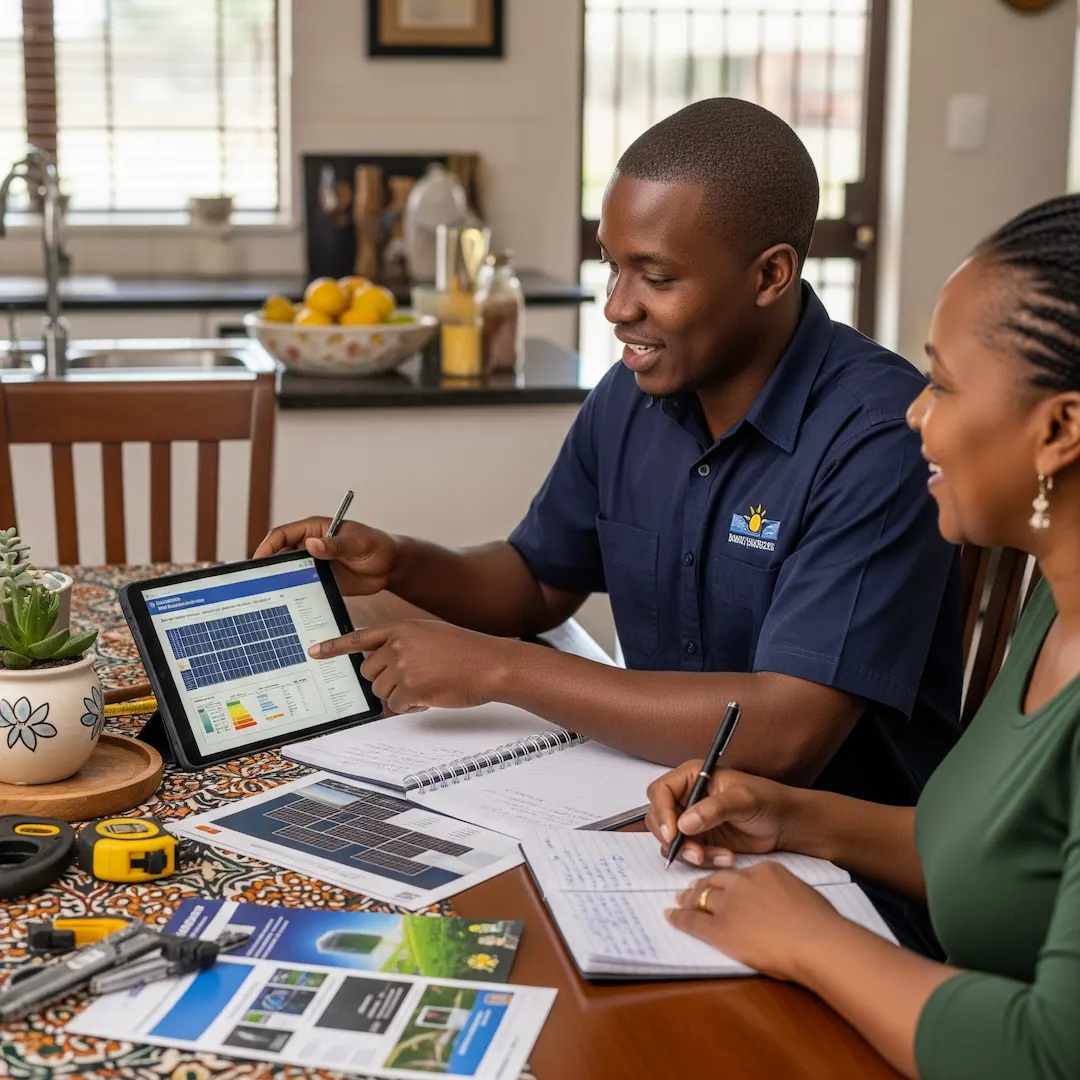
Knowing what to expect can help you identify a true professional. The process should feel thorough and collaborative, not like a high-pressure sales pitch.
- The Initial Conversation: The consultant will want to understand your primary goals. Are you trying to slash your electricity bill? Do you want seamless backup power during load shedding? Are you aiming to go completely off-grid? Your goals dictate the type of system you need (grid-tied, hybrid, or off-grid).
- The Data Gathering: Be prepared to provide at least 3-6 months of your electricity bills. The consultant will perform the site survey mentioned earlier and may ask you to keep a log of when you use major appliances.
- The Proposal Presentation: This is where you separate the pros from the cowboys. A professional proposal is a detailed document, not just a single-page quote with a final price. It should clearly outline:
- A complete list of proposed components (panel make and model, inverter specs, battery chemistry and capacity).
- The system's projected energy output, often shown as a monthly or annual kilowatt-hour (kWh) figure.
- A financial breakdown, including an estimated return on investment (ROI) or payback period.
- A clear and itemised cost breakdown (equipment, labour, CoC, any other fees).
- Detailed warranty information for all major components.
- A basic schematic or layout diagram showing how the system will be configured.
The Cost of Getting it Wrong vs. The Value of Getting it Right
We recently heard from a family in Durban who learned this the hard way. They chose an installer based on the cheapest quote. The installer put a small, undersized inverter and battery in their home. The system worked fine during the day, but every evening when they started cooking dinner, the system would trip. It simply couldn't handle the load from the stove and microwave running at the same time. They were still at the mercy of load shedding, despite having spent over R100,000.
Investing a small portion of your budget in proper, upfront design and consultation is your best insurance policy. It ensures that every rand you spend on equipment is working as hard as it possibly can for you. The result is a system that delivers on its promise: real savings, reliable power, and genuine peace of mind for years to come. Your journey to energy independence is a marathon, not a sprint, and it starts with the right first step.
Frequently Asked Questions (FAQs)
What's the difference between a grid-tied, hybrid, and off-grid system?
A grid-tied system is connected to the municipal grid and uses it as a "battery," but provides no power during load shedding. An off-grid system is completely independent of the grid and relies solely on panels and a large battery bank. A hybrid system is the most popular choice in South Africa; it's connected to the grid but also has batteries, allowing you to store solar power for use during load shedding or at night.
Do I need batteries for my solar system?
It depends on your goals. If you only want to reduce your monthly electricity bill and don't need backup power for load shedding, a grid-tied system without batteries can work. However, to have power during outages and to use your stored solar energy at night, batteries are essential. Most South African homeowners opt for systems with batteries.
How does shading from a neighbour's tree affect my solar panel output?
Shading can have a major impact. In a standard string inverter system, if even one panel is significantly shaded, the performance of all other panels in that same string can be dragged down to the level of the shaded panel. This is why a professional shading analysis is so important. An expert might suggest using micro-inverters or power optimisers to mitigate the effects of partial shading.
Can I add more panels or batteries to my system later?
Yes, but only if the system is designed for it from the start. A key part of the initial consultation is discussing future plans. Your designer can recommend an inverter that can handle additional panels in the future and a battery system that is modular and expandable. Trying to add components to a system that wasn't designed for expansion can be complex and expensive.
Find a vetted electrician near you
Solar system design and consultation: find a pro near you
- Solar system design and consultation near you
- Solar system design and consultation in Johannesburg
- Solar system design and consultation in Sandton
- Solar system design and consultation in Midrand
- Solar system design and consultation in Roodepoort
- Solar system design and consultation in Randburg
- Solar system design and consultation in Pretoria
- Solar system design and consultation in Cape Town
Suzette Meyer is the lead author and content creator for Kandua.com, South Africa’s #1 marketplace for home services. Suzette has made it her mission to help homeowners with advice on all aspects of home repair, maintenance and improvement, including how to choose the right Pro and how to make smart upgrades that improve your resale value or save costs.

Latest articles, advice and more
.webp)
.webp)
.webp)
.webp)
.jpeg)
Sinking Pavers, Weeds and Water That Pools: What Your Driveway Is Telling You
When your driveway starts sprouting weeds, pooling water, or sinking in patches, the bricks are not failing you. The layers underneath have moved, and they are trying to tell you exactly what went wrong.
.webp)
.webp)
Beyond the Unboxing: A Detailed Guide to Correct Washing Machine Plumbing & Setup
New washing machine in South Africa? Learn essential plumbing and setup tips to prevent leaks, ensure efficient operation, and extend your appliance’s lifespan - expert advice before your first load.
.webp)
New Washing Machine? Don't Plug It In Yet! Essential Installation Tips for SA Homes
Installing a new washing machine? Learn the essential setup steps South African homeowners often overlook to prevent leaks, noise, and damage—and ensure efficient, long-lasting performance from day one.
.webp)
.webp)
%25201200%2520x%25201200%2520(1).jpeg)
What Retiling a Bathroom Costs in 2026, Room by Room
Retiling a bathroom in South Africa costs between R230 and R800 per square metre in 2026, including materials and labour. A standard family bathroom, stripped and fully retiled, usually lands between R11,800 and R27,500. A guest toilet costs a fraction of that. A large porcelain en-suite costs a lot more.
How to Install a Horizontal Geyser | Step-by-Step Pro Guide
Want to install a geyser like a pro? This step-by-step tutorial shows you exactly how to do a horizontal Ariston Axios geyser installation, straight from the BluLever plumbing workshop. 🎥 Hosted by MK, BluLever’s technical facilitator, and supported by a qualified electrician, Life and a BluLever graduate artisan, Zinhle. This is your ultimate guide to a SANS 10254-compliant installation — from preparing the wall, to plumbing, electrical wiring, and pro troubleshooting tips.
How to Maintain a Geyser | Step-by-Step Pro Guide
Want to maintain a geyser like a pro? This step-by-step tutorial shows you exactly how to do the three core geyser maintenance checks on an Ariston Axios geyser installation, straight from the BluLever plumbing workshop. 🎥 Hosted by MK, BluLever’s technical facilitator, and supported by a qualified electrician, Life. This is your ultimate guide to geyser maintenance — from diagnosing the problem to checking the heat regulation of the geyser, to pressure regulation and then finally corrosion protection.
%201.avif)
Not just another newsletter. It's an advantage