
Enhancing Your Property Security: The Importance of Professional Electric Fence Installation in SA
Electric fence not working in South Africa? Discover why certified repair expertise is essential for safety, legal compliance, and restoring real security - don’t risk quick fixes when your property is at stake.

Electric Fence Not Working? Why Certified Repair Expertise Guarantees Your Property's Security in SA
That sinking feeling in the pit of your stomach when you realise your electric fence isn't working is all too familiar for many South African homeowners. The silent, inactive fence that was once your first line of defence now feels like an open invitation. In that moment, your priority isn't just getting it fixed—it's getting it fixed right so you can feel secure again.
While the temptation to find a quick, cheap fix or even tinker with it yourself might cross your mind, this is one area where cutting corners can have severe consequences. An electric fence is a high-voltage security system, and its repair requires more than just a bit of DIY know-how. It demands certified, professional expertise to ensure it’s not only functional but also safe and legally compliant.
This guide explains why turning to a qualified professional is the only choice when your property's security is on the line.
The High-Stakes Reality: Why DIY Electric Fence Repair is a Dangerous Gamble
It’s easy to underestimate the power running through those thin wires. You might think, "It's not working, so there's no power, right?" This is a dangerous and often incorrect assumption.
Our network of vetted electricians frequently shares cautionary tales. One expert recently recounted a callout in a Johannesburg suburb where a homeowner had attempted to re-tension a sagging wire himself. He had switched off the energizer at the wall, assuming it was safe. What he didn’t know was that the energizer's internal capacitor still held a powerful charge. When his pliers touched the live and earth wires simultaneously, he received a severe shock that threw him from his ladder. Luckily, his injuries weren't life-threatening, but it’s a stark reminder that "off" doesn't always mean "safe."
Here’s why you should never attempt to repair an electric fence yourself:
- Serious Electric Shock Hazard: Electric fence energizers convert low-voltage power into high-voltage pulses, often reaching 8,000 to 10,000 volts. Even when unplugged, capacitors can retain this charge. A qualified technician knows how to safely discharge the system before beginning any work.
- Risk of Fire: Incorrect wiring, using the wrong type of components, or creating faulty connections can lead to sparks and short circuits, creating a genuine fire hazard, especially near dry vegetation or thatch roofing.
- Legal & Insurance Compliance: In South Africa, electric fences are governed by strict regulations, specifically SANS 10222-3. An incorrectly repaired fence may be deemed non-compliant. If your non-compliant fence harms someone (even an intruder), you could be held liable. Furthermore, your insurer may reject a claim related to a break-in if your security system was found to be faulty or improperly maintained.
Common Reasons Your Electric Fence Has Stopped Working
A professional technician doesn't just guess; they diagnose. They understand that a "dead" fence can be caused by a number of issues, ranging from simple to complex.
Here are some of the most common faults they look for:
Faults with the Energizer
The energizer is the heart of your fence. If it fails, the whole system fails.
- No Power: This could be as simple as a tripped circuit breaker or a loose plug, but it could also indicate a failure in the unit's internal power supply.
- Lightning Damage: In areas like Gauteng and the Highveld, lightning strikes are a primary cause of energizer failure. A nearby strike can send a surge through the system, frying its sensitive electronic components.
- Internal Component Failure: Like any electronic device, internal parts can simply wear out and fail over time.
Faults on the Fence Line
More often than not, the problem lies somewhere along the fence perimeter itself. These are often difficult to spot for an untrained eye.
- A Direct Short Circuit: This is the most frequent culprit. It happens when a live wire touches anything that will divert the current to the ground. Common causes include:
- Overgrown Vegetation: Tree branches, creepers, or thick bushes touching the wires. A technician in a coastal area like Durban once described a fault that only occurred when the wind blew a large bougainvillea branch against a wire. It took a systematic check with a voltmeter to isolate the intermittent problem.
- Broken or Cracked Insulators: The black or white plastic bobbins that hold the wires can become brittle from sun exposure, crack, and allow the live wire to touch the metal mounting bracket.
- Sagging or Broken Wires: Wires that have lost tension can touch each other or a metal pole, causing a short. Rust can also weaken wires until they snap.
- Poor Earthing: The earth spikes are a critical, yet often neglected, part of the system. For a shock to be delivered, the circuit must be completed through the ground. If your earthing system is inadequate, corroded, or disconnected, the fence will have very low power, making it an ineffective deterrent.
What a Certified Repair Process Looks Like
When you call a true professional, you're not just paying for a repair; you're investing in a systematic process that guarantees safety and effectiveness.
Here’s what you should expect:
- Safety First: The first step will always be to safely power down and disconnect the energizer from both the mains power and the fence line. They will confirm the system is de-energized before proceeding.
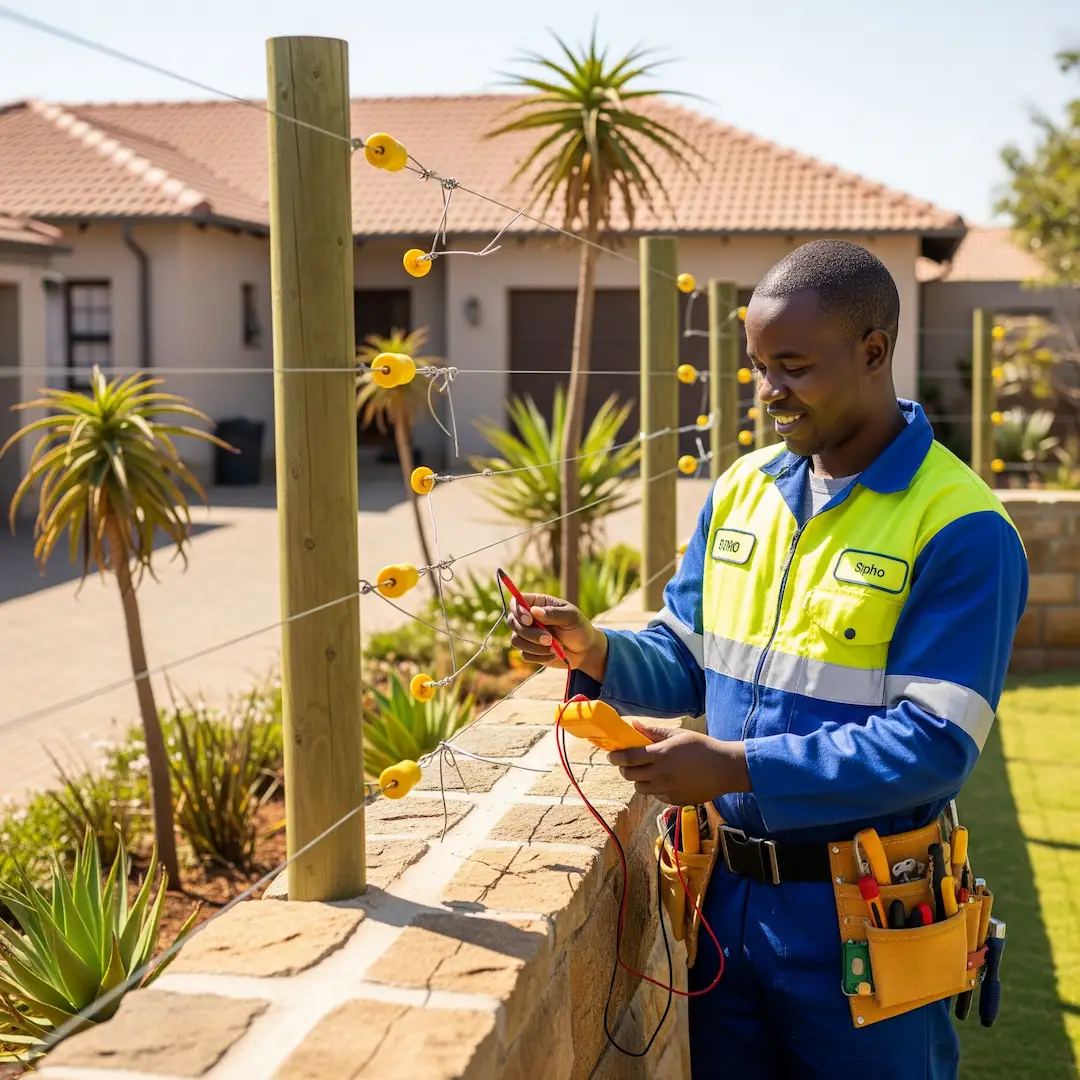
- Diagnostic Testing: They will use specialized tools like a digital voltmeter or a fault finder. This equipment allows them to test the voltage output from the energizer and then test sections of the fence line to pinpoint exactly where the voltage drop or short circuit is occurring.
- Thorough Inspection: They will walk the entire perimeter, visually inspecting the wires for tension, checking for broken insulators, looking for signs of arcing (telltale black marks), and clearing away any encroaching vegetation.
- Clear Explanation and Quoting: Once the fault is identified, the technician should explain the problem to you in clear, understandable terms. They will show you the faulty component and provide a transparent quote for the necessary parts and labour before commencing the repair.
- Professional Repair & Testing: They will use the correct, high-quality components (e.g., UV-stabilised insulators, correct gauge wiring) to perform the repair. Afterwards, they will reconnect and re-test the entire system to ensure it is operating at the correct voltage and is fully functional.
- Compliance Advice: A good technician will also point out any other compliance issues they notice, such as missing warning signs or incorrect fence height, helping you keep your installation safe and legal.
Choosing Your Technician: Look for These Non-Negotiable Credentials
To ensure your fence is repaired safely and correctly, your chosen technician must be properly qualified. In South Africa, the law is very clear on this.
- Department of Employment and Labour (DEL) Registration: Any person who installs or repairs an electric fence for a fee must be registered by the DEL as an "Electric Fence System Installer". Ask to see their registration card. This is the single most important credential.
- Certificate of Compliance (COC) Issuing Authority: A registered installer is also authorised to issue an Electric Fence System Certificate of Compliance. While a COC is only legally required for new installations or when a property is sold, the ability to issue one is a hallmark of a qualified professional.
- Demonstrable Experience: They should be able to speak confidently about different types of energizers and common faults specific to your area.
Your home's security is paramount. When your electric fence fails, it’s a vulnerability you need to close quickly and effectively. By entrusting the job to a certified, experienced professional, you’re not just fixing a wire; you’re restoring your peace of mind and ensuring your first line of defence is as strong, safe, and reliable as it was designed to be.
Frequently Asked Questions
How often should I have my electric fence serviced?
It is highly recommended to have your electric fence professionally inspected and serviced at least once a year. Regular servicing can identify potential issues like degrading insulators, vegetation overgrowth, or poor wire tension before they cause a complete failure. For properties in coastal areas with salt spray or areas with very fast-growing vegetation, a check-up every six months might be more appropriate.
Can my electric fence be repaired during loadshedding?
Yes, in most cases. The diagnostic and repair work on the fence line itself does not require mains power. A professional technician can identify shorts, replace insulators, and re-tension wires without electricity. They will only need power to be restored to test the energizer and the final voltage on the fence line once the physical repairs are complete. Most energizers also have a battery backup that will keep the fence running through outages anyway.
What does an Electric Fence Certificate of Compliance (COC) cover?
An Electric Fence System COC is a legal document issued by a registered installer declaring that the installation complies with all safety and legal requirements under the SANS 10222-3 standard. It certifies that the fence is the correct height, has adequate warning signs correctly placed, is not leaning over a neighbour's property, and that all electrical components are installed safely and correctly. It does not, however, guarantee the working condition of the components for any period of time.
Why is my electric fence alarm going off for no reason?
This is typically caused by an intermittent short circuit or "arcing" on the fence line. The alarm is triggered when the fence's monitoring system detects a sudden, significant drop in voltage. This is often caused by a loose wire, a cracked insulator, or a tree branch that only touches the wire when the wind blows. A technician can use a fault finder to trace the source of the intermittent voltage drop and resolve the issue.
Find a vetted electrician near you
Electric fencing repair: find a pro near you
Suzette Meyer is the lead author and content creator for Kandua.com, South Africa’s #1 marketplace for home services. Suzette has made it her mission to help homeowners with advice on all aspects of home repair, maintenance and improvement, including how to choose the right Pro and how to make smart upgrades that improve your resale value or save costs.

Latest articles, advice and more
.webp)
.webp)
.jpeg)
Sinking Pavers, Weeds and Water That Pools: What Your Driveway Is Telling You
When your driveway starts sprouting weeds, pooling water, or sinking in patches, the bricks are not failing you. The layers underneath have moved, and they are trying to tell you exactly what went wrong.
.jpeg)
What Your Garage Door Motor Actually Does (And Why It Breaks)
Spoiler alert: your garage door motor isn't actually doing the heavy lifting. The torsion springs carry almost all the weight. The motor simply pushes, pulls, controls the descent so it doesn't slam, and acts as a lock when the door is shut. That’s why a relatively small box on your ceiling can move such a massive door. Want to test this? Pull the red manual release cord and lift the door by hand. If it glides up easily and stays put when you let go, your springs are doing their job, and the fault lies with the motor. If the door feels like dead weight or slams back down- stop. You’ve got a spring problem.
.jpeg)
4 Warning Signs Your Tiles Are Failing (And What They Mean)
Tiles rarely fail overnight. They warn you first. A hollow sound underfoot, grout that crumbles away, a tile that lifts at one edge, or a crack that runs across two tiles all point to something happening under the surface. Here is what each sign means, and how urgent it is.
.webp)
.webp)
Beyond the Unboxing: A Detailed Guide to Correct Washing Machine Plumbing & Setup
New washing machine in South Africa? Learn essential plumbing and setup tips to prevent leaks, ensure efficient operation, and extend your appliance’s lifespan - expert advice before your first load.
.webp)
New Washing Machine? Don't Plug It In Yet! Essential Installation Tips for SA Homes
Installing a new washing machine? Learn the essential setup steps South African homeowners often overlook to prevent leaks, noise, and damage—and ensure efficient, long-lasting performance from day one.
.webp)
.webp)
%25201200%2520x%25201200%2520(1).jpeg)
What Retiling a Bathroom Costs in 2026, Room by Room
Retiling a bathroom in South Africa costs between R230 and R800 per square metre in 2026, including materials and labour. A standard family bathroom, stripped and fully retiled, usually lands between R11,800 and R27,500. A guest toilet costs a fraction of that. A large porcelain en-suite costs a lot more.
How to Install a Horizontal Geyser | Step-by-Step Pro Guide
Want to install a geyser like a pro? This step-by-step tutorial shows you exactly how to do a horizontal Ariston Axios geyser installation, straight from the BluLever plumbing workshop. 🎥 Hosted by MK, BluLever’s technical facilitator, and supported by a qualified electrician, Life and a BluLever graduate artisan, Zinhle. This is your ultimate guide to a SANS 10254-compliant installation — from preparing the wall, to plumbing, electrical wiring, and pro troubleshooting tips.
How to Maintain a Geyser | Step-by-Step Pro Guide
Want to maintain a geyser like a pro? This step-by-step tutorial shows you exactly how to do the three core geyser maintenance checks on an Ariston Axios geyser installation, straight from the BluLever plumbing workshop. 🎥 Hosted by MK, BluLever’s technical facilitator, and supported by a qualified electrician, Life. This is your ultimate guide to geyser maintenance — from diagnosing the problem to checking the heat regulation of the geyser, to pressure regulation and then finally corrosion protection.
%201.avif)
Not just another newsletter. It's an advantage