
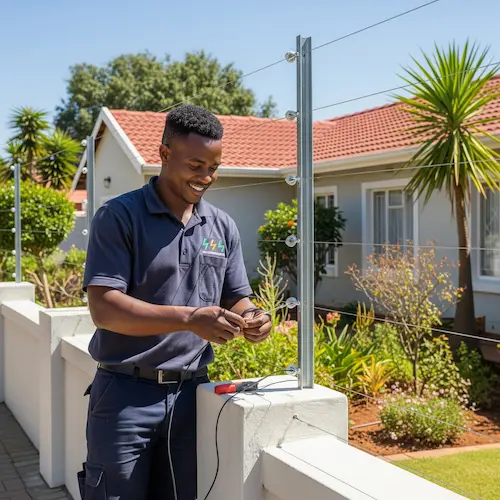
Securing Your Property in South Africa: Understanding Electric Fencing for Home Safety
Considering electric fencing for home security? Learn how electric fences work, their key benefits, and why they’re a popular, effective safety solution for South African properties.

Securing Your Property in South Africa: Understanding Electric Fencing for Home Safety
In South Africa, where home security is a primary concern for many, electric fencing has become a widespread and effective solution. It's more than just a visible barrier; it's a sophisticated system designed to deter intruders and provide an early warning. But what exactly is electric fencing, and how does it contribute to a safer home environment? Let's delve into the mechanics, benefits, and components of this essential security measure.
What is Electric Fencing?
At its core, electric fencing is a perimeter security system that delivers a non-lethal, high-voltage shock to anyone attempting to climb over or cut through it. The primary purpose isn't to cause harm, but rather to act as a powerful deterrent. The mere presence of an electric fence is often enough to make potential intruders think twice. If an attempt is made, the shock is designed to be memorable and uncomfortable, discouraging further intrusion.
Think of it like this: A homeowner in Pretoria recently shared an anecdote with one of our trusted installers. They had a conventional wall, but regular attempts were being made to breach it. After installing an electric fence, not only did the intrusions stop, but they also noticed that the neighbourhood's overall sense of security improved. The visible wires and warning signs sent a clear message.
How Does Electric Fencing Work as a Deterrent?
The effectiveness of electric fencing as a deterrent lies in a combination of factors:
- Psychological Impact: The sight of multiple strands of wire, often topped with warning signs, immediately communicates that the property is protected. Intruders prefer easy targets, and an electric fence signifies a higher risk.
- Physical Barrier: While not impassable, the physical structure of the fence, often reaching significant heights, makes it difficult to climb without making contact with the live wires.
- Shock Factor: When contact is made, a short, sharp, high-voltage pulse is delivered. This shock is disorienting and uncomfortable, causing the intruder to recoil. It's not a continuous current, but rather precisely timed pulses that maximise the deterrent effect without causing serious injury.
- Alarm Integration: Most modern electric fences are connected to an alarm system. Any attempt to tamper with or cut the wires triggers an alarm, alerting the homeowner and/or a security company. This immediate response significantly reduces the time an intruder has to gain entry.
One of our installers in Durban recounted a story about a property where an attempted break-in was thwarted precisely because of the immediate alarm activation. The security company arrived within minutes, long before the culprits could make their way into the house, purely because the electric fence had done its job.
Key Components of an Electric Fencing System
Understanding the different parts of an electric fence helps appreciate its comprehensive security capabilities:
- Energiser: This is the "brain" of the system. It converts mains power into high-voltage pulses, typically ranging from 5,000 to 10,000 volts, though the current is very low, making it safe but effective. The energiser also continuously monitors the fence line.
- Fencing Wires: These are typically galvanised or stainless steel wires stretched tautly around the perimeter. They are arranged in multiple strands, ensuring that any attempt to breach the fence will likely result in contact with a live wire.
- Insulators: Made from durable, non-conductive materials, insulators prevent the electric current from earthing (shorting out) through the posts. They ensure the current stays within the wires.
- Poles/Posts: These provide the structural support for the fencing wires and insulators. They need to be robust and firmly anchored to withstand tension and environmental factors.
- Warning Signs: Legally required and strategically placed, these signs alert people to the presence of an electric fence. They deter accidental contact and reinforce the psychological deterrent.
- Earth Spikes/Rods: Essential for the system's effectiveness, earth spikes provide a path for the electrical pulse to return to the energiser once contact is made. Without a proper earth, the shock would be significantly diminished.
- Siren/Alarm: Integrated with the energiser, the siren activates when the fence is tampered with or breached, providing an audible warning.
- Battery Backup: Most systems include a battery backup to ensure the fence remains active during power outages, a crucial feature in many South African areas.
An experienced electrician from Johannesburg mentioned the importance of quality components, particularly the energiser. "You can have the best wires and posts, but if your energiser isn't reliable and powerful enough, your fence is just a visual barrier. A good energiser is what makes it a real security system."
Is Electric Fencing Effective for Security?
Absolutely. Electric fencing is widely regarded as one of the most effective perimeter security measures available in South Africa. Its effectiveness stems from:
- Active Deterrence: Unlike passive barriers like walls, electric fences actively defend the perimeter by delivering a shock.
- Early Warning System: The alarm integration provides immediate notification of a breach attempt, giving homeowners vital time to react.
- Layered Security: Electric fencing works best when integrated into a broader security strategy, complementing alarm systems, CCTV, and physical barriers.
- Reduced Response Time: By triggering an alarm, it often reduces the time security services need to respond to an incident.
- Low Maintenance (when properly installed): Once installed correctly by a qualified professional, electric fences require relatively little ongoing maintenance beyond occasional checks and vegetation trimming.
It's important to remember that while DIY can be tempting for some aspects of home maintenance, installing an electric fence is not one of them. It involves working with high voltage and requires adherence to specific safety standards, such as those outlined in SANS 10222-3. Incorrect installation can render the fence ineffective, dangerous, or even illegal. Always consult with and use qualified and accredited professionals for electric fence installations.
Frequently Asked Questions
How often does an electric fence need to be serviced?
Ideally, an electric fence should be serviced at least once a year by a qualified technician. This ensures all components are functioning correctly, the voltage is optimal, and there are no potential weak points in the system. Regular checks can also identify potential issues caused by weather or vegetation.
Can an electric fence be linked to a security company?
Yes, most modern electric fence energisers have outputs that can be connected to alarm systems, which in turn can be monitored by a security company. This means that if your fence is tampered with, the security company will be immediately alerted and can dispatch a response team.
What happens to the electric fence during a power outage?
Most well-installed electric fences include a battery backup system. This battery is continuously charged by the mains power and automatically takes over to power the energiser during a power outage, ensuring your perimeter remains secure. The duration the battery can power the fence varies depending on its capacity and the fence's power consumption.
Is an electric fence dangerous for pets or children?
While the shock from an electric fence is designed to be non-lethal, it can be unpleasant. Reputable installers will advise on appropriate installation heights and clear warning sign placement to minimise the risk to children and pets. The brief pulse nature of the shock typically causes a quick withdrawal without lasting harm.
Find a vetted electrician near you
Electric fencing installation: find a pro near you
- Electric fencing installation near you
- Electric fencing installation in Johannesburg
- Electric fencing installation in Sandton
- Electric fencing installation in Midrand
- Electric fencing installation in Roodepoort
- Electric fencing installation in Randburg
- Electric fencing installation in Pretoria
- Electric fencing installation in Cape Town
Suzette Meyer is the lead author and content creator for Kandua.com, South Africa’s #1 marketplace for home services. Suzette has made it her mission to help homeowners with advice on all aspects of home repair, maintenance and improvement, including how to choose the right Pro and how to make smart upgrades that improve your resale value or save costs.

Latest articles, advice and more
.webp)
.webp)
.jpeg)
Sinking Pavers, Weeds and Water That Pools: What Your Driveway Is Telling You
When your driveway starts sprouting weeds, pooling water, or sinking in patches, the bricks are not failing you. The layers underneath have moved, and they are trying to tell you exactly what went wrong.
.jpeg)
What Your Garage Door Motor Actually Does (And Why It Breaks)
Spoiler alert: your garage door motor isn't actually doing the heavy lifting. The torsion springs carry almost all the weight. The motor simply pushes, pulls, controls the descent so it doesn't slam, and acts as a lock when the door is shut. That’s why a relatively small box on your ceiling can move such a massive door. Want to test this? Pull the red manual release cord and lift the door by hand. If it glides up easily and stays put when you let go, your springs are doing their job, and the fault lies with the motor. If the door feels like dead weight or slams back down- stop. You’ve got a spring problem.
.jpeg)
4 Warning Signs Your Tiles Are Failing (And What They Mean)
Tiles rarely fail overnight. They warn you first. A hollow sound underfoot, grout that crumbles away, a tile that lifts at one edge, or a crack that runs across two tiles all point to something happening under the surface. Here is what each sign means, and how urgent it is.
.webp)
.webp)
Beyond the Unboxing: A Detailed Guide to Correct Washing Machine Plumbing & Setup
New washing machine in South Africa? Learn essential plumbing and setup tips to prevent leaks, ensure efficient operation, and extend your appliance’s lifespan - expert advice before your first load.
.webp)
New Washing Machine? Don't Plug It In Yet! Essential Installation Tips for SA Homes
Installing a new washing machine? Learn the essential setup steps South African homeowners often overlook to prevent leaks, noise, and damage—and ensure efficient, long-lasting performance from day one.
.webp)
.webp)
%25201200%2520x%25201200%2520(1).jpeg)
What Retiling a Bathroom Costs in 2026, Room by Room
Retiling a bathroom in South Africa costs between R230 and R800 per square metre in 2026, including materials and labour. A standard family bathroom, stripped and fully retiled, usually lands between R11,800 and R27,500. A guest toilet costs a fraction of that. A large porcelain en-suite costs a lot more.
How to Install a Horizontal Geyser | Step-by-Step Pro Guide
Want to install a geyser like a pro? This step-by-step tutorial shows you exactly how to do a horizontal Ariston Axios geyser installation, straight from the BluLever plumbing workshop. 🎥 Hosted by MK, BluLever’s technical facilitator, and supported by a qualified electrician, Life and a BluLever graduate artisan, Zinhle. This is your ultimate guide to a SANS 10254-compliant installation — from preparing the wall, to plumbing, electrical wiring, and pro troubleshooting tips.
How to Maintain a Geyser | Step-by-Step Pro Guide
Want to maintain a geyser like a pro? This step-by-step tutorial shows you exactly how to do the three core geyser maintenance checks on an Ariston Axios geyser installation, straight from the BluLever plumbing workshop. 🎥 Hosted by MK, BluLever’s technical facilitator, and supported by a qualified electrician, Life. This is your ultimate guide to geyser maintenance — from diagnosing the problem to checking the heat regulation of the geyser, to pressure regulation and then finally corrosion protection.
%201.avif)
Not just another newsletter. It's an advantage