
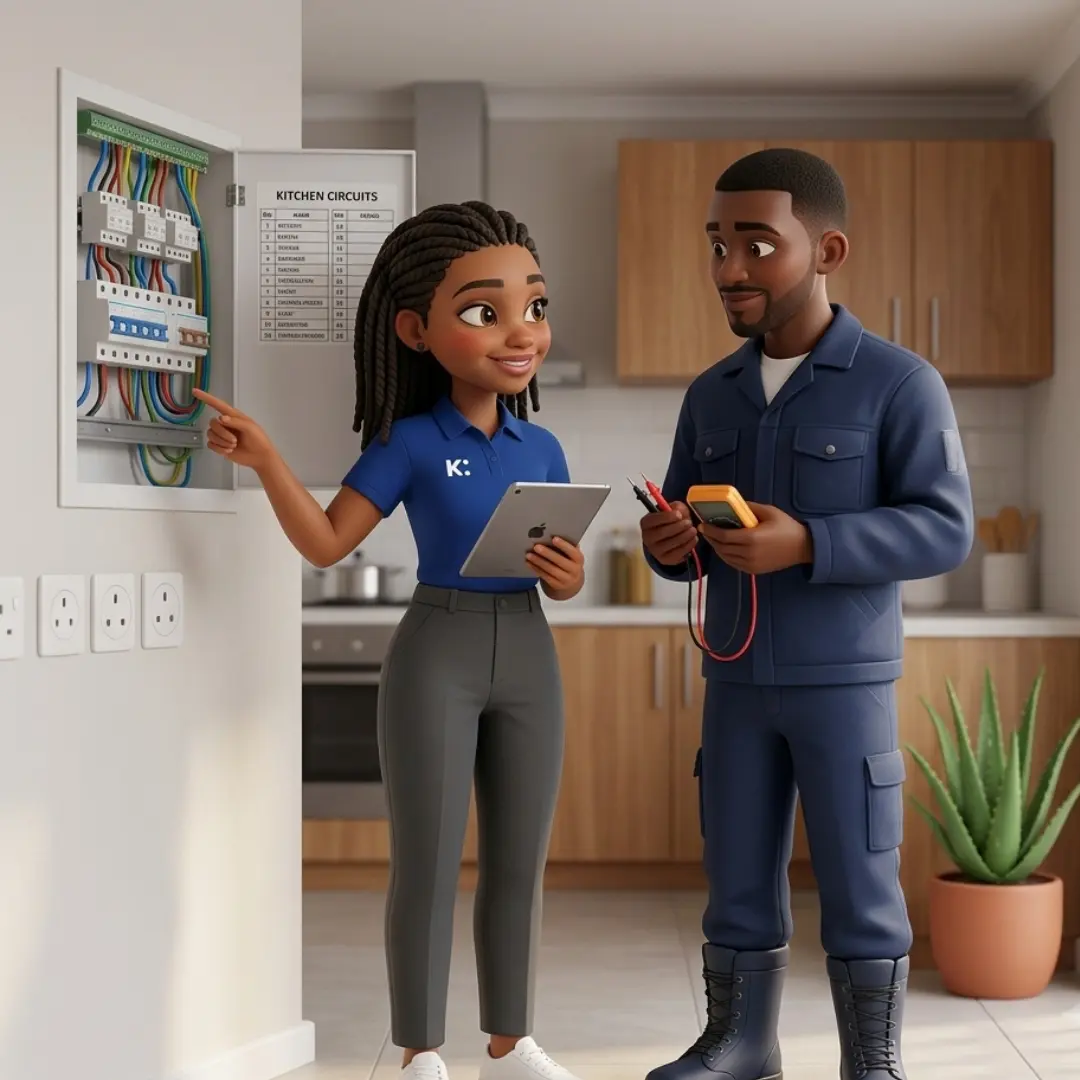
Why Are My Plug Points Not Working? A Troubleshooting Guide
If your plug points have suddenly gone dead, the usual culprits are a tripped earth leakage switch, a tripped circuit breaker, loose or burnt wiring, or a faulty appliance overloading the circuit. Work through the safety checks below before you call anyone, then understand when the job requires a registered electrician.

Summary: Dead plug points are usually caused by a tripped DB board switch, a faulty appliance, or damaged wiring. While you can safely troubleshoot basic issues by testing appliances and resetting your circuit breakers, warning signs like burning smells, scorch marks, or buzzing require an immediate shutdown. In South Africa, fixed electrical repairs legally require a registered electrician with a Wireman’s Licence to maintain your Certificate of Compliance (COC) and keep your home insurance valid. For effortless diagnosis and quick connections to vetted, licensed electricians, Kandua is ready to help guide you through the next steps.
If your plug points have suddenly gone dead, the usual culprits are a tripped earth leakage switch, a tripped circuit breaker, loose or burnt wiring, or a faulty appliance overloading the circuit. Work through the safety checks below before you call anyone, then understand when the job requires a registered electrician.
Why Your Plug Points Stop Working
A dead plug point almost always traces back to one of these:
- Tripped earth leakage: This is the big switch on your DB board that cuts power the instant it senses a fault, often the first thing to go.
- A tripped circuit breaker: Each breaker protects one circuit, so a single trip can kill several plugs in one room.
- A faulty appliance: A failing kettle, heater, or charger can trip the circuit the moment it is switched on.
- Loose or burnt wiring: Years of heat and load can work a connection loose inside the socket or the DB board.
- A dead circuit: Sometimes the breaker itself fails, or the wiring on that run has been damaged.
Knowing which one you are dealing with is half the battle, and it tells you whether this is a two-minute reset or a job for a pro.
First Check Is It One Plug Point or the Whole Circuit
Before you touch anything, walk through the house. Plug a lamp or phone charger into points in different rooms.
If only one socket is dead, the fault is likely at that specific point or its wiring. If a whole room or section is out, you are looking at a tripped breaker or earth leakage on that circuit. If the entire house is dark, first rule out load shedding or a wider outage by checking whether your neighbours have power. Eish, sometimes it really is just Eskom.
Read: DB Board Repairs in South Africa: Understanding Common Faults & Solutions
Reset Your Earth Leakage and Circuit Breakers
Head to your distribution board (the DB board) and open the cover. Look for any switch sitting in the middle or off position rather than fully up.
- Identify the tripped switch. The earth leakage is usually the larger switch, often with a test button. Circuit breakers are the smaller individual switches.
- Switch it fully off first, then firmly back on. Flicking it straight from the middle position often will not hold.
- Watch what happens. If it stays on, you are sorted. If it trips again straight away, do not keep forcing it. That repeated trip is a warning, not a glitch.
A breaker that trips the moment you reset it is telling you that something on that circuit has a genuine fault. That is your cue to move to the next check.
Try the Faulty Appliance Test
Often the problem is not your wiring at all; it is something plugged into it.
Unplug every appliance on the affected circuit. Reset the breaker or earth leakage. If it now holds, plug your appliances back in one at a time. When the power trips again, the last appliance you connected is your culprit. Set it aside and have it looked at or replaced. Kettles, heaters, old extension leads, and cheap chargers are common offenders.
When the Plug Point Itself Is Faulty
Some signs point straight at the socket. A faint burning smell, brown scorch marks, a warm faceplate, a buzzing sound, or a plug that feels loose in the socket all suggest the wiring behind the point has worked loose or overheated.
Switch off that circuit at the DB board and stop using the point. Do not open the faceplate yourself. Behind that small cover sits live wiring, and a loose live connection is exactly the kind of fault that starts fires inside the wall where you cannot see it. This is where the troubleshooting ends and a qualified pair of hands begins.
The Point Where DIY Becomes a Legal Matter
In South Africa, fixed electrical work is not a grey area. Under the Electrical Installation Regulations, 2009 (issued under the Occupational Health and Safety Act), every electrical installation must comply with SANS 10142-1, the national wiring code. Work on your fixed wiring, sockets, or DB board must be carried out and signed off by a registered person holding a Wireman's Licence.
That sign-off is your Certificate of Compliance (COC), the legal document proving the work is safe and up to standard. It matters for two reasons. First, safety. Second, if an unregistered person does the work and something goes wrong later, your insurer can question the claim. Replacing a faulty plug point yourself might feel like a small job, but the moment it touches fixed wiring it falls inside this legal red line.
Read: Do I Need a Certificate of Compliance for Electrical Work?
Let Kandua help you find the right service pro for your home maintenance job or repair: www.kandua.com
Frequently Asked Questions
Why do my plug points keep tripping the earth leakage?
Repeated tripping usually means there is a real earth fault on the circuit, often a faulty appliance, moisture in a socket, or damaged wiring. Use the appliance test to isolate it. If the earth leakage trips with everything unplugged, the fault is in the wiring and needs a registered electrician.
Can I replace a plug point myself in South Africa?
Legally, fixed electrical work must comply with SANS 10142-1 and be signed off by a registered person with a Wireman's Licence. Even a simple socket swap touches your fixed wiring, so it falls inside the regulated zone. Doing it yourself can also affect your insurance and your COC.
Why is only one plug point not working when the rest are fine?
A single dead socket usually points to a fault at that specific point, often a loose or burnt connection behind the faceplate, rather than a circuit wide trip. Stop using it, switch off the circuit and have an electrician inspect it.
How do I know if it is load shedding or an actual fault?
Check the schedule and whether your neighbours have power. If the whole area is out, it is the grid. If your home is dark but the street is on, look at your DB board for a tripped main switch or earth leakage.
What is a COC and do I need one for plug point repairs?
A Certificate of Compliance is a legal document confirming your electrical installation meets SANS 10142-1. You need a valid COC when selling a property, and insurers may require one. Any registered work on your plugs or wiring should be covered by it.
Is a burning smell from a plug point dangerous?
Yes. A burning smell or scorch marks signal overheating wiring, which is a fire risk. Switch off that circuit at the DB board immediately, stop using the point and get a registered electrician out as soon as possible.
How much does it cost to fix a faulty plug point?
It depends on whether it is a simple socket replacement or a deeper wiring fault. You can ask Jess for a price benchmark so you know the typical range for your area before agreeing to any work.
Suzette Meyer is the lead author and content creator for Kandua.com, South Africa’s #1 marketplace for home services. Suzette has made it her mission to help homeowners with advice on all aspects of home repair, maintenance and improvement, including how to choose the right Pro and how to make smart upgrades that improve your resale value or save costs.

Related articles, advice and more
.webp)
Latest articles, advice and more
.webp)
How To Fix A Damp Wall And What's Actually Causing It
If your walls are weeping, your plaster is flaking, or you can smell that musty, damp smell, you're not dealing with one problem; you're dealing with three possible ones. The fix depends entirely on the cause.
.webp)
Gutter Cleaning: How Often Should You Do It and What Does It Cost?
Clean your gutters at least twice a year, and always before your rainy season kicks in. In South Africa, a professional gutter clean usually costs somewhere between R450 and R2,500, depending on the size of your home, how high the roof is, and how blocked things have become. Here is how to work out the right frequency and a fair price.
.webp)
Why Are My Plug Points Not Working? A Troubleshooting Guide
If your plug points have suddenly gone dead, the usual culprits are a tripped earth leakage switch, a tripped circuit breaker, loose or burnt wiring, or a faulty appliance overloading the circuit. Work through the safety checks below before you call anyone, then understand when the job requires a registered electrician.
.webp)
How a Geyser Timer Can Cut Your Electricity Bill
If you've been staring at your Eskom bill and wondering where the money is going, your geyser might be the culprit. Here's the good news: a simple geyser timer can cut your hot water costs by up to 30% each month, which typically saves South African homeowners between R200 and R400 on their electricity bills, depending on their current usage.
%20(1).webp)
How To Treat and Paint Over Damp Walls (So It Doesn't Come Back)
You've noticed a patch on the bedroom wall: discoloured and maybe a bit soft to the touch, and you're wondering if a fresh coat of paint will simply cover the problem. The short answer: no, it won't. But the good news is that understanding what's happening beneath that stain, and treating it properly, is far simpler than you might think.
.webp)
Beyond the Unboxing: A Detailed Guide to Correct Washing Machine Plumbing & Setup
New washing machine in South Africa? Learn essential plumbing and setup tips to prevent leaks, ensure efficient operation, and extend your appliance’s lifespan - expert advice before your first load.
.webp)
New Washing Machine? Don't Plug It In Yet! Essential Installation Tips for SA Homes
Installing a new washing machine? Learn the essential setup steps South African homeowners often overlook to prevent leaks, noise, and damage—and ensure efficient, long-lasting performance from day one.
%20(1).webp)
.webp)
TV Repair Costs in South Africa: Diagnosing Screen, Power & Component Issues
Find out what TV repairs really cost in South Africa – from call-out and diagnosis fees to screen, power and main board fixes – and when it’s cheaper to replace your TV instead of repairing it.
.webp)
Septic Tank Leak Repair Cost in South Africa: Addressing Odours & Environmental Hazards
Learn typical septic tank leak repair costs in South Africa, what drives the price up, how to spot early warning signs (odours, soggy ground, backups), and when it’s safer and cheaper to get a professional in.
How to Install a Horizontal Geyser | Step-by-Step Pro Guide
Want to install a geyser like a pro? This step-by-step tutorial shows you exactly how to do a horizontal Ariston Axios geyser installation, straight from the BluLever plumbing workshop. 🎥 Hosted by MK, BluLever’s technical facilitator, and supported by a qualified electrician, Life and a BluLever graduate artisan, Zinhle. This is your ultimate guide to a SANS 10254-compliant installation — from preparing the wall, to plumbing, electrical wiring, and pro troubleshooting tips.
How to Maintain a Geyser | Step-by-Step Pro Guide
Want to maintain a geyser like a pro? This step-by-step tutorial shows you exactly how to do the three core geyser maintenance checks on an Ariston Axios geyser installation, straight from the BluLever plumbing workshop. 🎥 Hosted by MK, BluLever’s technical facilitator, and supported by a qualified electrician, Life. This is your ultimate guide to geyser maintenance — from diagnosing the problem to checking the heat regulation of the geyser, to pressure regulation and then finally corrosion protection.
%201.avif)
Not just another newsletter. It's an advantage


From problem to solved.


.svg)


.avif)
.avif)
.avif)


.avif)